Pages

11 April 2026

Twin box tomb lids link Pickman family in two Salem, Massachusetts, burial grounds

In 1938, the Works Progress Administration (WPA) completed several projects in Salem, Massachusetts, including a map of veterans’ graves at Broad Street Cemetery. Laid out in 1655, the burial ground contains just over one hundred military graves from the Revolution, the War of 1812, the Civil War, and the Spanish-American War.

Curiously, the map mislabels the Pickman box tomb (B-8) as Col. Timothy Pickering’s burial site. His box tomb, however, is located on the hill (C-10) overlooking the 17th-century Pickering House. My theory is that “Pick” was legible on the Pickman lid but not much else, leading to the misidentification. If so, that tells me the early 20th-century-style slate lid on the Pickman box tomb was placed after 1938.

The Pickman lid at Broad Street has a twin at the Charter Street Cemetery/Old Burying Point. It's the same early 20th-century-style slate, with a family crest in the top left corner, for the Barton-Toppan-Pickman box tomb. 

Below, I've provided the text from each tomb lid, then generational family groupings with names in bold for people who are buried in the tomb. Photos of the lids are at the end.

06 February 2024

Book review: Evolution of Religions

The Evolution of Religions [book cover]
Think your family genealogy is complex? Imagine creating a family tree of organized religions! 

Evolution of Religions: A History of Related Traditions by Lance Grande (New York: Columbia University Press, 2023)

Comparative religion books are often written by religious scholars or historians. But this one has a twist: It’s written by a scientist—an evolutionary biologist and systematist to be exact. There’s beauty in having a scientist write such a book. Lance Grande remains neutral, or agnostic if you will, to the different religions. His purpose is to analyze how organized religions came into being, how they change and evolve over time, and how they create new groups and subgroups—or become extinct.

Organized religions developed from early supernaturalism into Asian cyclicism, Old World polytheism, linear monotheism, traditional and reformation Christianity, gnosticism and Biblical demiurgism, and Islam. Grande focuses on each group’s origin and development, doctrines, rituals/practices, and supernatural beings/deities from prehistoric times to today. 

From that evolutionary perspective, Grande discovers the history of related traditions (as in the title). He shows how, for example, the Abrahamic religions (Judaism, Christianity, Islam) are historically and ideologically intertwined, but also how they diversified—by using historical and scriptural records. The amazingly detailed charts help us visualize the relationships between religions and the subgroups that grew out of them, while the sidebars, images, and glossary provide additional context.

It’s an imperfect science due to changing archaeological interpretations and new discoveries, variables in oral traditions and written transcriptions, and the physical destruction or recovery of scriptures. That's why Grande created the framework and then invites others to fill in the missing pieces and build upon his work.

Evolution of Religions is a big book, but it’s written in such a methodical way that you’ll understand the broad concepts behind many organized religions around the world.

Prerelease book provided for review consideration.

30 August 2023

Book review: Crime and Punishment in Tudor England: From Alchemists to Zealots


Although witches, or the fear of them, date to Biblical times, it wasn’t until 1542 that the first English statute on witchcraft was enacted by King Henry VIII (1491-1547). His son Edward VI (1537-1553) repealed it, but then Elizabeth I (1533-1603) put her own 1563 statute on the books. She divided witchcraft into greater and lesser crimes. Invoking evil spirits or killing someone through sorcery was punishable by death, while injuring people or property meant a year of imprisonment and time in the pillory. Second acts meant death. However, it was during the Stuart dynasty when witchcraft accusations ran rampant, since King James I (1566-1625) not only added his own statutes, he wrote a book on the subject.

English laws and the penalties for breaking them were harsh. While the Tudor era ended before the Winthrop fleet arrived on the shores of Massachusetts Bay Colony, some of the crueler penalties were not abolished until the 19th century. Fortunately, the Puritan colonists created the first 100 rules of 1641's Body of Liberties based on the Bible—and used more humane treatment compared to what they left behind in England.

In 1692 Salem, Massachusetts, however, when Giles Corey refused to enter a plea in court, he was pressed to death for it. This gruesome punishment, also known as Peine forte et dure, was only used once stateside. But it was not abolished in England until 1772. In fact, in English courts the accused was not given the option of pleading “not guilty” until 1827. 

Other examples include a thief who steals bread could get a hand cut off, while a vagrant could get branded with the letter V. Some punishments were designed for maximum humiliation, with the crowds throwing rotten foodstuff at convicts in the cart or at the pillory. That was tame compared to being drawn and quartered, then hanged—again, with crowd participation.

If you’re looking for more details on Crime and Punishment in Tudor England, pick up the new book by April Taylor. The author provides background information on lawmaking, prisons, and courts systems—and 23 pages of punishments, from beheading to whipping. In the second half of the book, crimes from sumptuary laws to treason are covered in alphabetical order, each followed by case studies. You’ll learn what evidence could be used against the accused, what tortures could be applied to gain a confession, and even the strategies used for the criminal’s demise.

Taylor turns crime and punishment in the Tudor period into a fascinating read, while the alpha-order format makes it easy to browse through or do research.

Prerelease book provided by NetGalley and Pen & Sword History for review consideration.

30 April 2023

Understanding Rose's story by reading a book

Recently, I've been doing research on a relative's family. His grandmother Rose was diagnosed with multiple sclerosis (MS) in her early 40s, around the time when her only child was graduating from high school. The disease went into remission for a short while but by the time Rose was in her late 50s, her husband no longer could provide the specialized care she needed. Rose moved into the local nursing home, where her husband visited her every day. 

Whenever her out-of-state grandsons visited, Rose always reminded them that she once was a registered nurse. Clearly, her status as an RN meant a lot to her, especially since the boys only saw her disabled body lying in a hospital bed in a depressing nursing home. Unlike some of her peers, Rose graduated from high school and was accepted as a nursing student at a hospital 30 miles away. It was one of the few careers open to women at the time. The hospital, like many others, expected much of their female students. Besides studying, for three years the nursing students worked at the hospital before graduating. Six months later, the trained nurses had to pass a board-certified examination in order to become a Registered Nurse. Of the 102 nursing students, Rose was one of 33 who received an honor seal on her RN certificate for having an average grade of 90 percent or more in all subjects. 

Rose had fallen in love with her future husband long before she became a nurse. I know because I have a box of letters that she she wrote to her hometown beau during the entire time she lived in the hospital students' dormitory 30 miles away. Yet Rose put off marriage and having children to follow her dream of being a nurse. After all, one of the hospital rules (and other institutions like it) was that anyone who marries while in training was expelled from the nursing program. One year after she was officially an RN, Rose married.

24 March 2023

Book review: The Shortest History of Europe

Unless you're just collecting names and dates, your genealogy research becomes richer the more you know about history, religion, and culture. Putting your ancestors in context not only helps you understand their lives within their own times, but gives you better direction on what to look for in sources and what to research next. 


If you need a refresher, check out The Shortest History series published by The Experiment LLC. Current books in the series include Europe, England, Germany, Israel and Palestine, India, China, and Greece, with more in the works. Promoted as Thousands of years of history. One riveting, fast-paced read, the series is written by expert historians who are also international bestselling authors.

The title says it all: The Shortest History of Europe: How Conquest, Culture, and Religion Forged a Continent—A Retelling of Our Times. This is not a sprawling narrative filled with name-dropping and stringent timelines. Instead, John Hirsts narrative explores how Greek and Roman learning, Christianity, and German warrior culture created modern Europe. 

At first, its hard to absorb how only three elements determined the course of European history. But Hirst shows how all the monumental events happened because of conquest, culture, and religion. 

For example, the Catholic Church banished or executed great thinkers like Copernicus and Galileo because their interpretations of how the universe worked contradicted the Greco-Roman view. Martin Luther and his followers wanted to return Christianity to its basic form—the Bible—without the Greco-Roman trappings and started the Reformation. Many years later, Isaac Newton and Einstein explained their scientific discoveries by following the Greek theory that answers would be simple, mathematical, and logical.

Throughout the book and its many revolutions, Hirst synthesizes European history in a way that went beyond my college classes, yet is simple and accessible.   


10 September 2022

Smallpox in Massachusetts Bay 1689-1692

While researching an article for my Witches of Massachusetts Bay website, I wanted to find out if Martha (Allen) Carrier brought that contagious disease, the smallpox with her when she moved from Billerica to Andover in the summer or early fall of 1690. 

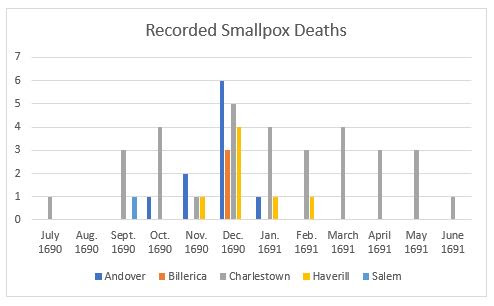
Like my previous smallpox post, the data is limited by who recorded the deaths in each town and whether they included a cause of death. After the 1678–1679 outbreak, the period from 1689 to 1692 had 55 cases. The earliest death was Dr. John Smith in Charlestown on 21 October 1689 and the last was Thomas Rand who died on 17 June 1691, also in Charlestown. Of all the recorded smallpox deaths, Charlestown had the most prolonged time period between the first and last smallpox deaths and the largest recorded deaths (34). The remaining smallpox deaths were in Andover (10), Haverhill (7), Billerica (3), and Salem (1). Clearly, the Charlestown town recorder was more diligent than the Salem one, since we would expect a busy seaport such as Salem to have more cases.

The records did not supply a timeframe for when the virus raged in each community or how many had the disease and survived. However, we do know from the selectmen's records that by mid-October 1690, Martha Carrier and some of her children had smallpox, and all recovered. But, all of the people who died of the disease in Andover were related to Martha, including her father, two brothers, and two nephews.

The Andover selectmen blamed Martha Carrier for bringing the contagion to Andover. The records show that the first smallpox death recorded in Andover was on 24 October 1690, while the first one listed in Billerica occurred two months later, on 24 December 1690. This suggests—but does not prove—that the disease hit Andover first, and Billerica later.


Andover

Andrew Allen jr., small pox. 24 Oct 1690
Andrew Allen Sr., small pox 26 Nov 1690
John Allen, small pox, Nov. 26, 1690.
Francis Ingalls, s. Henry and Mary, small pox, Dec. 9, 1690.
James Holt, "father of James," small pox, Dec. 14, 1690.
James Holt, s. James and Hannah, small pox, Dec. 13, 1690.
Mercy Allen, w. John, small pox, Dec. 25, 1690.
Sarah Marks, w. Roger, small pox, Dec. 22, 1690.
Thomas Allen, s. Andrew and Elisabeth, small pox, Dec. 18, 1690.
Stephen Osgood, smallpox, Jan. 15, 1690-1.

Billerica

Daniel Shed, small pox, Dec. 24, 1690, a. abt. 41. [Dan[ie]ll Jr., M.R.]
Dorothy Shed [dup. Dorithy], d. Daniel Jr. [dup. omits Jr.] and Ruth, small pox, Dec. 23, 1690.
John Dunkin Sr. [h. Johannah], small pox, Dec. 19, [16]90.

Charlestown

Dr. John Smith, smallpox, d. Oct. 21, 1689.
Abigail Kettle, wife of Jonathan Kettle, (smallpox), d. Jan. 25, 1690.
John Damman, about 40, (smallpox), d. Jan. 20, 1690.
John Hett, son of Tho. & Dorothy Hett, (smallpox), d. Jan. 8, 1690.
Susanna Codman, dau. of Stephen & Elizabeth Codman, (smallpox), d. Jan. 8, 1690.
James Miller, son of James Miller, the Scotchman, smallpox, d. July 14, 1690.
John Hale, about 26, (smallpox), d. Sept. [Dec, Co. Rec. 4:182] 30, 1690.
Mary Cutler, dau. of Timothy & Elizabeth Cutler, smallpox, d. Sept. 12, 1690.
Sarah Cutler, dau. of Timothy & Elizabeth Cutler, smallpox, d. Sept. 5, 1690.
Henry Bowers, son of Benanuel Bowers, about 25, (smallpox), d. Oct. 16, 1690.
Mary Hill, dau. of Samuel & Elizabeth Hill, smallpox, d. Oct. 4, 1690.
Sarah Shoorin, wife of Thomas Shoorin, (smallpox), d. Oct. 17, 1690.
William Wilson, son of Paul Wilson, (smallpox) Oct. 4, 1690.
John Hurry, son of Wm. & Hannah Hurry, smallpox, d. Nov. 22, 1690.
Elizabeth Het, dau. of Tho. & Dorothy Het, (smallpox), d. Dec. 14, 1690.
Henry Davis, a sojourner at Jno. Chamberlin's [a stranger, Co. Rec. 4:183], (smallpox), d. Dec. 20, 1690.
John Chamberlain, (smallpox), d. Dec. 22, 1690
John Ryal, son of Joseph & Mary Ryal, 11, (smallpox), d. Dec. 21, 1690.
Joseph Hopkins, about 32, smallpox, d. Dec. 27, 1690.
Alice Dam, servant to Capt. Joseph Lynde, smallpox, d. Feb. 18, 1690/1.
Hephzibah Codman, dau. of Stephen & Elizabeth Codman, (smallpox), d. Feb. 22, 1690 [1690/1, Pro. 1].
Sarah Mirick, wife of Benjamin Mirick, smallpox, d. Feb. 14, 1690/1.
Abigail Orton/Horton, wife of Ebenezer Orton, (smallpox), d. Mar. 27, 1691.
Edward Paine, brickmaker, (smallpox), d. Mar. 13, 1690/1.
John Kettle, about 30, smallpox, d. Mar. 17 [18, Pro. 2], 1690/1.
Thankfull Austin, wife of Ebenezer Austin, (smallpox), d. Mar. 4, 1690 [1690/1, Pro. 1].
[blank] of Jno. Smith, (smallpox), d. Apr. 29, 1691
George Luke, son of George & Hannah Luke [smallpox, Pro. 1], d. Apr. 11, 1691 [altered from 1690].
Samll. Carter, smallpox, d. Apr. 1, 1691.
[blank] of Jno. Smith, (smallpox), d. May 11, 1691.
Anna Ballat, wife of Mr. Samll. Ballat, smallpox, d. May 14, 1691.
Mary Smith, wife of Jno. Smith, (smallpox), d. May 22, 1691,
Thomas Rand, son of Nathaniel & Abigail Rand, (smallpox), d. June 17, 1691.
John Smith, ship carpenter, (smallpox), d. 1691.

Haverhill

Tho[mas] Mash, s. Onisophorus, of Canada, pox, Nov. 21, 1690.
Abraham Hendrick, s. Daniel and Mary (Stockbridge), smallpox, Dec. 1, 1690.
Jonah Sterling, s. William and Mary, small pox, Dec. 21, 1690.
Jonathan Davis, s. Ephraim and Mary (Johnson), small pox, Dec. 7, 1690.
Ruth Hartshorne, w. John, small pox, Dec. 12, 1690
Mary Ford, w. Robert, small pox, Jan. 27, 1690-91.
Mary Ford, d. Robert and Mary (Kent), small pox, Feb. 3, 1690-91.

Salem

Jacob Phillips, small pox, Sept. 19, 1690. C. R. 2.


*Data only included information from Massachusetts Vital Records 1620–1850 database at AmericanAncestors.org, which does not include records for every town. Boston Births, Baptisms, Marriages, and Deaths 1630–1699 were searched separately, though the keywords “smallpox,” “small pox,” and “pox” were not found. 


See also


A pox on Martha Carrier (WitchesMassBay)


18 July 2022

Book Review: Aunt Edwina's Fabulous Wishes by Lynne Christensen

Located in a fancy spa town in England, Fizzleywick Hotel is a grand place for the wedding of your imagination. That's right, Canadian author Lynne Christensen has set her family history novel in Plumsden and Brambleford and other quaint towns in Kent that you won't find on the map. After all, it's more about the adventure than the destination. You shouldn't be seeking the help of Amelia Georges of the Pixleton Family History Society anyway; just know that volunteers and staff in real places will provide you with resources to uncover genealogical clues—but it's your job to do the work. So call ahead to make reservations and don't be daunted by unexpected events, untimely closures, and not finding everything you need in one place. 

Thanks to Aunt Edwina, Julie and her cousin Gertie embark on a family history treasure hunt. They need to find scattered clues left behind in family papers, paintings, and even the landscape itself. With the help of friends in high and low places, the two women find secret stashes hidden in everyday objects and within people's memories. The people they meet, from a pawn shop owner to aristocrats turned B&B hosts, all help them solve the puzzles. 

From charming characters to precise descriptions of imaginary locations, this book is an entertaining but smart read. Did you ever think about attending an antiques market to learn where an old key fits? Or taking the time to meet with the locals who have all sorts of stories to tell? In the end, Julie and Gertie are successful, but like all family trees, there's always more to discover. That's why Aunt Edwina's Fabulous Wishes is book 1 of a series. 


(received free book to review)


16 January 2020

Before the court: Massachusetts Bay records

Records of the Court of Assistants of the Colony of the Massachusetts Bay, 1630-1692

1630 to 1641: Records, so far as recovered or reproduced from State Archives
1641 to 1644
1642 to 1673 Restored fragments of records
1673 to 1692 (missing Intercharter period, part 1686-part 1689)

Criminal trials in the Court of Assistants and Superior Court of Judicature, 1630-1700 by John Noble (1897)

Abstract and index of the records of the Inferior court of pleas, Suffolk County Court, Held at Boston, 1680-1698

Records and Files of the Quarterly Courts of Essex County, Massachusetts

Vol. I 1636-1656
Vol. II 1656-1662
Vol. III 1662-1667
Vol. IV 1667-1671
Vol. V 1672-1674
Vol. VI 1675-1678
Vol. VII 1678-1680
Vol. VIII 1680-1683
Vol. IX 1683-1686

Records of the Governor and Company of the Massachusetts Bay in New England

v. 1. 1628-1641
v. 2. 1642-1649
v. 3. 1644-1657
v. 4, pt. 1. 1650-1660
v. 4, pt. 2. 1661-1674
v. 5. 1674-1686

Massachusetts State Archives collection, colonial period, 1622-1788

v. 135 Witchcraft, 1656-1759

FamilySearch record images (click on camera icon on right to view digital records)


27 October 2019

Reconstructing Rev. George Burroughs’ Genealogy

1711 Attainder for George Burroughs & Others
Rev. George Burroughs left his Salem Village post in 1683, preferring life in the Maine wilds with occasional Indian attacks than dealing with the animosity brewing in Salem, Massachusetts. In 1692 he returned to Salem in chains on trumped up charges of being “in confederacy with the Devil.” 

At age 42, Burroughs stood before his former congregation and many other spectators at Proctor’s Ledge with a noose around his neck. He proclaimed his innocence on the charges of witchcraft, then perfectly recited the “Lord’s Prayer.” A sense of unease apparently swept through the crowd afterwards but Rev. Cotton Mather, sitting on horseback, declared it was a “righteous sentence.” Burroughs and four other victims of the Salem witch trials were hanged on 19 August 1692.

Incorporating Corrections to the Burroughs Tree


Over the last 65 years, various researchers have discovered new details about George Burroughs’ family and printed corrections, most notably in articles published in The American Genealogist. Yet we still see the same misinformation being repeated online and in print. I’ve compiled all that data so George can be properly placed with his parents, wives, and children.

Burrough of Wickhambrook


Born about 1650, George was the son of Nathaniel Burrough and his wife Rebecca Stiles. Nathaniel was a merchant/mariner, son of Rev. George Burrough (1579-1653), rector of Pettaugh and Gosbeck in Suffolk, England, and a member of the Burrough family of Wickhambrook. During his son’s childhood, records document Nathaniel’s travels between Maryland and Massachusetts Bay. Records also show in 1657 Rebecca joined the church in Roxbury, Massachusetts, and was dismissed in 1674 to return to England. Rebecca (Stiles) Burrough was buried 26 March 1679 in Stepney, Middlesex, England. Nathaniel was buried there 6 March 1682.

*In England, the surname most often was spelled Burrough without the S, but there were a dozen variations.

Marriage No. 1


The ill-fated minister George Burroughs graduated from Harvard College in 1670. About 1673, he married Hannah Fisher, born 19 January 1652/3 in Dedham, Massachusetts, to Lieut. Joshua Fisher (1621-1672) and his first wife, Mary Aldis (d. 1653). George and Hannah had:

1. Rebecca Burroughs, baptized 12 April 1674 in Roxbury; died 27 January 1741/2, buried at Granary Burying Ground in Boston; married first, 1 December 1698 in Charlestown, Isaac Fowle; married second, 18 October 1716 in Boston, Ebenezer Tolman.
2. George Burroughs, baptized 25 November 1675 in Roxbury; died young.
3. Hannah Burroughs, born 27 April 1680 in Salisbury; died 5 August 1746 in Woburn, buried at First Burial Ground, Woburn; married 8 March 1705 in Boston, Jabez Fox (1684-1736).
4. Elizabeth Burroughs, born in 1681, baptized 4 June 1682 in Salem; died 1719, buried at Granary Burying Ground in Boston; married 2 November 1704 in Boston to Peter Thomas.

Hannah (Fisher) Burroughs died in September 1681, possibly shortly after her fourth child was born. Her ghost appeared in the Salem witch trials records.

Marriage No. 2


About 1683, George married Sarah Ruck, born 12 August 1656 in Salem, died about 1689/90, daughter of John Ruck (1627-1697) and his first wife Hannah Spooner (d. 29 January 1660/1) of Salem. Sarah was the widow of Capt. William Hathorne (1646-1678), son of Major William Hathorne (1606?-1681) and wife Ann of Salem. She had two Hathorne children who died in their minority. The proof of this earlier marriage is in a 1728 deed where her son Charles Burroughs, as his mother's heir, sells Capt. Hathorne's lands in Groton, Mass. Her ghost also appeared in the Salem witch trials records.

On 6 June 1693, John Ruck became guardian of George and Sarah’s four orphans (but not 1st wife Hannah’s children), and in the same month, Ruck had three of them baptized. In his 1697 will, he bequeathed land to his four Burroughs grandchildren:

5. Charles Burroughs, born about 1684, baptized June 1693 in Salem; married first, 3 October 1706 in Salem, Elizabeth Marston (d. 1711); married second, 11 March 1711 in Marlborough, Rebecca Townsend of Charlestown. 
6. George Burroughs, baptized April 1691 in Salem; published marriage intention 27 February 1713/4 in Ipswich to Sarah Scales.
7. Jeremiah Burroughs, baptized June 1693; died unmarried March 1752 in Ipswich. 
8. Josiah Burroughs, baptized June 1693; died after 1701 when he chose Samuel Ruck as guardian and before 1712 restitution.

Marriage No. 3


About 1690, George married his third wife, Mary —, probably in Maine. They had one child:

     9. Mary Burroughs, born about 1690-1692 in Maine, baptized 1 May 1698 in Cambridge, Massachusetts; married Joseph Tiffany probably years before they were warned out of Norton in 1734. She was admitted to the church in Attleborough in 1736.

In her mid-20s when her husband George was hanged, Mary (—) Burroughs married second, 13 July 1693 in Boston, Michael Homer—just months after his first wife Hannah (Dowse) died. In October 1694, Michael was taken to court for spousal abuse before disappearing from the records. In January 1697/8, Mary Homer was admitted a member of the Cambridge church and a few months later had her two daughters, Mary Burroughs and Hannah Homer, baptized. 

On 5 February 1699/1700, Mary (—) (Burroughs) Homer married in Cambridge to Christopher Hall Jr. (d. 1711). They had two children, Caleb (1700-1791) and Joshua Hall (1702-), born in Attleborough.


Sources for Burroughs’ Parents

“Nathaniel Burrough of Maryland, Massachusetts, and England” by George Ely Russell, The American Genealogist, Vol. 60, pp. 140-142, 1972. (TAG back issues are available to members at AmericanAncestors.org)

Genealogical Gleanings in England by Henry F. Waters, Vol.1, Vol. 2. 1:515f, 1:737, 2:1308f


Sources for Burroughs’ Wives & Children

“Homer-Stevens Notes, Boston” by Winifred Lovering Holman in The American Genealogist, Vol. 29, pp. 99-110, 1953.

“Mary (Burroughs) (Homer) (Hall) Tiffany” by Glade Ian Nelson in The American Genealogist, Vol. 48, pp. 140-146, 1972.

“The Third Wife of the Rev. George Burroughs” by David L. Greene in The American Genealogist, Vol. 56, pp. 43-45, 1980.

“Hannah Fisher, First Wife of the Rev. George Burroughs, Executed for Witchcraft in Salem, Massachusetts, 1692” by Neil D. Thompson, The American Genealogist, Vol. 76, pp. 17-19, 2001.

“Sarah (Ruck) (Hathorne) Burroughs of Salem, Massachusetts” by Glade Isaac Nelson in The American Genealogist, Vol. 91, pp. 23-28, 2019.


Originally published 19 Sept. 2017, updated with Capt. Hathorne data.


14 September 2019

Smallpox reported in Massachusetts Bay 1676-1688


As seen in Massachusetts: Vital Records, 1620-1850 (online database: AmericanAncestors.org, New England Historic Genealogical Society, 2001-2016), a few town clerks sometimes added notations for the cause of death, including smallpox. (Not all towns, such as Boston, are part of this database.)

Massachusetts Bay colonists first recorded smallpox in their communities in 1677, with epidemics also occurring in 1689–1690, 1702, 1721, 1751, 1764, and 1775. The highly infectious disease started with a fever followed in two or three days by a skin rash that turned into fluid-filled bumps with a dent in the center. Some colonists were familiar with or had the disease in the old country and knew that isolating its victims from the general population helped contain the spread of smallpox. But they did not have medical treatments or preventative measures.

Of the 4,283 deaths reported from 1676 to 1688 in the database, 32 notations mentioned death by smallpox. Typically, the rate of death after contracting the disease was 30 percent, though higher for babies. This suggests an average of 1,285 people died of smallpox, though only .74% were reported.

However, from the small sample (the 32 listed below), it’s possible to see how smallpox traveled (by placing the dates in order) and how relatives and neighbors were infected. 

Roxbury
----, Peter, a[n Indian] boy of Holbrook’s, small pox, 5: 11m : 1678-9. C.R. 1.
Davis, Samuel, s. Toby, small pox, bur. 10: 2m : 1679. C. R. 1.
Davis, Willia[m], small pox. at Boston, bur. 18: 10m: 1678. C. R. 1.
Gary (see also Garee, Gery), Dorcas, inf. d. ----, wid. Nathtaniel], small pox, bur. 21 : 12 m : 1678-9. C. R. 1.
Gery, Deborah [Gary, d. wid., small pox. C. R. 1.], Mar. 8, 1678 [1678-9. C. R. 1.]
Gery, Nathaniel [Gary, small pox. C. R. 1.], Jan. 28, 1678. [1678-9. C. R. 1.]
Goard, John [a young man], small pox, bur. 18: 12m: 1678-9. C. R. 1.
Goard, Phebe, w. Richard, small pox, bur. 28 : 12 m : 1678-9. C. R. 1.
Heath, Dorothy, d. wid., small pox, 3: 11m: 1678-9. C. R. 1.
Holbroke (see also Holbrook), John [Holbrook, small pox. C. R. 1.], Dec. 25, 1678.
Hopkins, Hannah, w. Willia[m], small pox, 5: 11m: 1678-9. C. R. 1.
Hopkins, Mary, small pox, bur. 8: 12m [Feb.]: 1678-9. C. R. 1.
Lamb, Mary, d. Caleb [small pox. C. R. 1.], July 4, 1679.
Newel, Abraham [Newell, C. R. 1.], s. Isaac [small pox: C. R. 1.], Dec. 25, 1678. [a. 11 y. C. R. 1.]
Newel, Jakob, small pox, 30: 10m: 1678. C. R. 1.
Newel, Mary, d. Jakob, small pox, 5: 12m: 1678-9. C. R. 1.
Stevens, ____, small pox, 13: 10m: 1678. C. R. 1.
Tatman (see also Totman), Elizabeth, inf. d. Jabesh, small pox, 30:9m: 1678. C. R. 1.
Weld, Elisabeth, w. Joseph [small pox. C. R. 1.], Feb. 15, 1678. [1678- 9. C. R. 1.]
Weld, Margaret [Marget. C. R. 1.], d. Joseph and Elisabeth [small pox. C. R. 1.], Feb 12. 1678.
Williams, Theoda, small pox, bur, 8: 12m: 1678-9. C. R. 1.
Wise, Jeremiah, small pox, 17 : 9m: 1678. C. R. 1.

Billerica
Hamlet, Mary, w. Jacob, small pox, July 9, [16]78.

Newbury
Beedle, ________, ch. Robert, small pox, Jan. 4, 1678. [Jan. 9. CT. R.]
Blanchard, John, small pox, July 24, 1678.
Lunt, ________, ch. John, small pox, Sept. 30, 1678.
Moody, Judith, d. Caleb, small pox, at Salisbury, Jan. 28, 1678.
Morse, ________, ch. Joseph, small pox, Feb. 5, 1678.
Morse, Joseph, small pox, Jan. 15, 1678.

Woburn
Cutler, John, Sen., s. of ____, of the small-pox, in the family of Isaac Brooks, 1678 or 1678-79.
Farrar, Jacob, s. of ____, of small-pox, 1678 or 1678-9.
Wyman, David, s. of ____, of small-pox, 1678 or 1678-9.


03 August 2019

Using the Essex Institute Historical Collections

Essex Institute, Salem, Mass., circa 1910s
The Essex Institute of Salem, Massachusetts, was formed in 1848 by the merger of the Essex Historical Society and the Essex County Natural History Society. This literary, historical, and scientific society had a deep interest in Essex county, 

In 1992, the Essex Institute merged with the Peabody Museum to become the Peabody Essex Museum (PEM).

One hundred years of the Essex Institute Historical Collections (EIHC) is available online through the Internet Archive. The journals contain family genealogies, histories, probate records, and other miscellaneous records of interest to genealogists.

Indices


Vol. 1 Essex Institute Historical Collections (1859)

Vol. 2 Essex Institute Historical Collections (1860)

Vol. 3 Essex Institute Historical Collections (1861)

Vol. 4 Essex Institute Historical Collections (1862)

Vol. 5 Essex Institute Historical Collections (1863)

Vol. 6 Essex Institute Historical Collections (1864)

Vol. 7 Essex Institute Historical Collections (1865)

Vol. 8 Essex Institute Historical Collections (1866)

Vol. 9 Essex Institute Historical Collections (1869)

Vol. 10 Essex Institute Historical Collections (1870)

Vol. 11 Essex Institute Historical Collections (1871)

Vol. 12 Essex Institute Historical Collections (1874)

Vol. 13 Essex Institute Historical Collections (1875)

Vol. 14 Essex Institute Historical Collections (1877)

Vol. 15 Essex Institute Historical Collections (1878)

Vol. 16 Essex Institute Historical Collections (1879)

Vol. 17 Essex Institute Historical Collections (1880)

Vol. 18 Essex Institute Historical Collections (1881)

Vol. 19 Essex Institute Historical Collections (1882)

Vol. 20 Essex Institute Historical Collections (1883)

Vol. 21 Essex Institute Historical Collections (1884)

Vol. 22 Essex Institute Historical Collections (1886)


Vol. 23 Essex Institute Historical Collections (1887)

Vol. 24 Essex Institute Historical Collections (1888)

Vol. 25 Essex Institute Historical Collections (1889)

Vol. 26 Essex Institute Historical Collections (1890)

Vol. 27 Essex Institute Historical Collections (1891)

Vol. 28 Essex Institute Historical Collections (1892)

Vol. 29 Essex Institute Historical Collections (1893)

Vol. 30 Essex Institute Historical Collections (1894)

Vol. 31 Essex Institute Historical Collections (1895)

Vol. 32 Essex Institute Historical Collections (1896)

Vol. 33 Essex Institute Historical Collections (1897)

Vol. 34 Essex Institute Historical Collections (1898)

Vol. 35 Essex Institute Historical Collections (1899)

Vol. 36 Essex Institute Historical Collections (1900)

Vol. 37 Essex Institute Historical Collections (1901)

Vol. 38 Essex Institute Historical Collections (1902)

Vol. 39 Essex Institute Historical Collections (1903)

Vol. 40 Essex Institute Historical Collections (1904)

Vol. 41 Essex Institute Historical Collections (1905)

Vol. 42 Essex Institute Historical Collections (1906)

Vol. 43 Essex Institute Historical Collections (1907)

Vol. 44 Essex Institute Historical Collections (1908)

Vol. 45 Essex Institute Historical Collections (1909)

Vol. 46 Essex Institute Historical Collections (1910)

Vol. 47 Essex Institute Historical Collections (1911)

Vol. 48 Essex Institute Historical Collections (1912)

Vol. 49 Essex Institute Historical Collections (1913)

Vol. 50 Essex Institute Historical Collections (1914)

Vol. 51 Essex Institute Historical Collections (1915)

Vol. 52 Essex Institute Historical Collections (1916)

Vol. 53 Essex Institute Historical Collections (1917)

Vol. 54 Essex Institute Historical Collections (1918)

Vol. 55 Essex Institute Historical Collections (1919)

Vol. 56 Essex Institute Historical Collections (1920)

Vol. 57 Essex Institute Historical Collections (1921)

Vol. 58 Essex Institute Historical Collections (1922)

Vol. 59 Essex Institute Historical Collections (1923)


Other Publications

Proceedings of the Essex Institute

Bulletin of the Essex Institute: Communications

Annual report of the Essex Institute


See more 

Digital Public Library of America

HathiTrust


25 March 2019

Sidney Perley's Essex Antiquarian

Born in 1857, Sidney Perley was a well-known lawyer in Essex county, Massachusetts. He also wrote books and articles on history, genealogy, and the law. From 1897 to 1909 he published the Essex Antiquarian. These journals include so much valuable information, I've included the links below. Perley died in 1928. 


For more articles published by Perley, check out my links to the Essex Institute Historical Collections (EIHC). He also wrote pieces for the New England Historic Genealogical Society (AmericanAncestors.org).

14 May 2018

The Peabody Essex Museum's Phillips Library collections: a timeline from 1799 to 2018


Inside the Phillips Library in Salem, Massachusetts, 1885
One of the oldest research libraries in the country, Phillips Library contains more than 400,000 rare books and 117,000 square feet of manuscripts, original papers, photographic images, and prints from Salem and Essex county, Massachusetts, to places around the world. It's probably best known as the repository for the 1692 Salem witch trials documents; letters and manuscripts from Nathaniel Hawthorne and his literary circle; plus ships' logs and maritime journals documenting travels to the Far East. 

Of particular interest are local family histories and town records, military records, original genealogical papers, newspapers and city directories, charts and maps, business and social records, papers of notable Americans, works of regional authors, broadsides and ephemera, publications from literary and historical societies, art and architecture books, history books, and materials related to its museum collections.

For more than 200 years, the Phillips Library collection has been an integral part of Salem. The timeline, below, shows how the Phillips Library started and grewand where it's headed next.

1799 East India Marine Society founded for creating a library on navigation and seafaring topics and collecting curiosities from native cultures of Polynesia, Micronesia, and Melanesia.

1821 Essex Historical Society founded.

1833 Essex County Natural History Society founded.

1848 Essex Institute formed by the union of the Essex Historical Society and Essex County Natural History Society; focus on literary, historical, and scientific pursuits; museum library, historic houses, educational programs, scholarly publications.

1857 Plummer Hall built for Salem Athenaeum with money provided in the 1845 will of Caroline Plummer; Essex Institute rented rooms at Plummer Hall for library and collections.

1867-1868 Peabody Academy of Science formed with the purchase of the East India Marine Hall along with the historic and ethnological collections of East India Marine Society. Essex Institute permanently transferred its natural history collections, originally collected by the Essex County Natural History Society, to the Peabody Academy. The Peabody Academy permanently transferred its historical collections to the Essex Institute, which concentrated its focus on local history, genealogy, and art.

1885 Essex Institute acquired the Daland house for the Phillips Library.

1905 Essex Institute bought Plummer Hall from Salem Athenaeum.

1915 Peabody Academy of Science changed its name to Peabody Museum of Salem, with its focus on maritime history of New England, Pacific and Japanese ethnology, and natural history of Essex county.

1972 National Register of Historic Places approves formation of the Essex Institute Historic District formed within the bounds of the Armory, Essex Street, Washington Square West, and Brown Street.

1992 Peabody Essex Museum (PEM) founded through consolidation of Peabody Museum of Salem and the Essex Institute. Within a few years, PEM changed its focus to become an arts and culture museum.   

1997 PEM’s Phillips Library closed for “massive restoration project, including climate control and modern archival storage” (closed 9 months).

2004 reduced hours and limited access to Phillips Library after laying off all but one librarian. At the same time, PEM said it would put “part of its 400,000 volumes and 2 million manuscript papers on the Internet.” Already 26,000 records had been scanned.

2011 Phillips Library is closed during “preservation and renovation work on Plummer Hall and Daland House (expected completion 2013)” (closed 19 months). During part of the closure, PEM exhibited 35 rare items as part of its Unbound, Highlights from the Phillips Library at PEM exhibit. 

2013 Phillips Library collection moved to temporary collection center in Peabody, with limited access to the library's resources. 

2015 PEM announced “$20 million renovation and improvement of PEM’s Phillips Library....housed in two noted 1850s architectural treasures, the John Tucker Daland House and Plummer Hall, both of which are being renovated by Schwartz/Silver Architects.” Part of the funds were used to digitally catalog the collections in PhilCat.

2017 Peabody Essex Museum purchased building in Rowley for its new Collections Center.

2018 Phillips Library moved to Collections Center in Rowley (closed Sept. 2017 to mid-June 2018)


28 February 2018

Introducing the Witches of Massachusetts Bay website

As some of you already know, I've been studying, researching, and writing about the Salem witch trials for 20+ years. I love Salem. But when I visit, I expect to see evidence of the 1692 witch trials. But where is the court house? The documents? The tangible objects that remind us of the victims, the accusers, the judges?

Good question.

Instead of blogging these last few months, I've been putting together my new Witches of Massachusetts Bay website. It launched in late January to highlight locations and artifacts as well as provide a calendar of related events, whether you’re headed on a roadtrip, interested in a lunchtime talk on John Proctor, or ready for the Daemonologie experience. I also added information for doing armchair research and, yes, started another blog.

Get Ready for a Roadtrip


Relevant historical and genealogical societies, museums, historic sites, libraries, and cemeteries are listed on the Roadtrips pages by town. In time, I would like to include detailed information about how each one fits into the witch-hunt theme. For example, the Macy-Colby House in Amesbury displays the wooden cradle from executed “witch” Susannah (North) Martin’s family; the Old North Parish Burial Ground in North Andover includes burials of accused witches William Barker Sr. and his son William Barker Jr.; the Danvers Archival Center has books, manuscripts, and pamphlets on witchcraft; and the Beverly Historical Society offers tours of the house where Rev. John Hale wrote his Modest Inquiry book on witchcraft. On the Roadtrips pages, I’ve also included online book and record links.

Witch-Hunt and 17th Century-Focused Events


It seems I always found out about an event after it happened. No more! Now you can find out when a local history society is giving a tour of the Old Burial Grounds, attend a lecture on a family involved in the witch hunts, visit a home connected to the trials, learn about Wampanoag lives, or experience History Camp Boston. The calendar includes ongoing exhibits and special events, like 17th century Saturdays, so you know what's happening before you go.

Help with Research


The Research section includes lists of accused witches and old place names—as well as digital collections, books, records, and multimedia online that encompass more than one location.

Blogging on 'Witches'


The blog is for witch-hunt-related news, the latest research, Q&As with historians, book notices, collections highlights, etc. For example, I did a Q&A with a novelist about her book on accused witch Abigail (Dane) Faulkner; used Google Maps’ fix function to correct which Bishop lived where; and discovered the somewhat unknown witch trial items at the Supreme Court in Salem.

Learning from the Past


By searching for these locations and researching witch-hunt connections, I hope to expand my own understanding, because, ultimately, I think the witch hunts have much to teach us as individuals and as a society. Some of the accused may have dabbled in fortunetelling, folk-healing, and the like, but they were not witches who made pacts with the devil, performed Satanic rites, or shapeshifted to harm their neighbors. They were ordinary people with flaws, just like you and me.

If you're a witch-hunt historian, researcher, descendant, or just curious, check out my Witches of Massachusetts Bay website. I also invite you to sign up for my occasional emails, follow me on Twitter @witchesmassbay and Facebook, and spread the word. Thanks!