Pages

Showing posts with label vital records. Show all posts

11 April 2026

Twin box tomb lids link Pickman family in two Salem, Massachusetts, burial grounds

In 1938, the Works Progress Administration (WPA) completed several projects in Salem, Massachusetts, including a map of veterans’ graves at Broad Street Cemetery. Laid out in 1655, the burial ground contains just over one hundred military graves from the Revolution, the War of 1812, the Civil War, and the Spanish-American War.

Curiously, the map mislabels the Pickman box tomb (B-8) as Col. Timothy Pickering’s burial site. His box tomb, however, is located on the hill (C-10) overlooking the 17th-century Pickering House. My theory is that “Pick” was legible on the Pickman lid but not much else, leading to the misidentification. If so, that tells me the early 20th-century-style slate lid on the Pickman box tomb was placed after 1938.

The Pickman lid at Broad Street has a twin at the Charter Street Cemetery/Old Burying Point. It's the same early 20th-century-style slate, with a family crest in the top left corner, for the Barton-Toppan-Pickman box tomb. 

Below, I've provided the text from each tomb lid, then generational family groupings with names in bold for people who are buried in the tomb. Photos of the lids are at the end.

10 September 2022

Smallpox in Massachusetts Bay 1689-1692

While researching an article for my Witches of Massachusetts Bay website, I wanted to find out if Martha (Allen) Carrier brought “that contagious disease, the smallpox” with her when she moved from Billerica to Andover in the summer or early fall of 1690. 

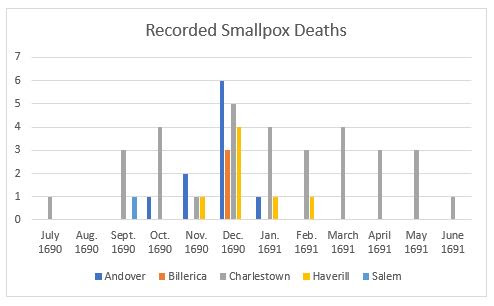
Like my previous smallpox post, the data is limited by who recorded the deaths in each town and whether they included a cause of death. After the 1678–1679 outbreak, the period from 1689 to 1692 had 55 cases. The earliest death was Dr. John Smith in Charlestown on 21 October 1689 and the last was Thomas Rand who died on 17 June 1691, also in Charlestown. Of all the recorded smallpox deaths, Charlestown had the most prolonged time period between the first and last smallpox deaths and the largest recorded deaths (34). The remaining smallpox deaths were in Andover (10), Haverhill (7), Billerica (3), and Salem (1). Clearly, the Charlestown town recorder was more diligent than the Salem one, since we would expect a busy seaport such as Salem to have more cases.

The records did not supply a timeframe for when the virus raged in each community or how many had the disease and survived. However, we do know from the selectmen's records that by mid-October 1690, Martha Carrier and some of her children had smallpox, and all recovered. But, all of the people who died of the disease in Andover were related to Martha, including her father, two brothers, and two nephews.

The Andover selectmen blamed Martha Carrier for bringing the contagion to Andover. The records show that the first smallpox death recorded in Andover was on 24 October 1690, while the first one listed in Billerica occurred two months later, on 24 December 1690. This suggests—but does not prove—that the disease hit Andover first, and Billerica later.


Andover

Andrew Allen jr., small pox. 24 Oct 1690
Andrew Allen Sr., small pox 26 Nov 1690
John Allen, small pox, Nov. 26, 1690.
Francis Ingalls, s. Henry and Mary, small pox, Dec. 9, 1690.
James Holt, "father of James," small pox, Dec. 14, 1690.
James Holt, s. James and Hannah, small pox, Dec. 13, 1690.
Mercy Allen, w. John, small pox, Dec. 25, 1690.
Sarah Marks, w. Roger, small pox, Dec. 22, 1690.
Thomas Allen, s. Andrew and Elisabeth, small pox, Dec. 18, 1690.
Stephen Osgood, smallpox, Jan. 15, 1690-1.

Billerica

Daniel Shed, small pox, Dec. 24, 1690, a. abt. 41. [Dan[ie]ll Jr., M.R.]
Dorothy Shed [dup. Dorithy], d. Daniel Jr. [dup. omits Jr.] and Ruth, small pox, Dec. 23, 1690.
John Dunkin Sr. [h. Johannah], small pox, Dec. 19, [16]90.

Charlestown

Dr. John Smith, smallpox, d. Oct. 21, 1689.
Abigail Kettle, wife of Jonathan Kettle, (smallpox), d. Jan. 25, 1690.
John Damman, about 40, (smallpox), d. Jan. 20, 1690.
John Hett, son of Tho. & Dorothy Hett, (smallpox), d. Jan. 8, 1690.
Susanna Codman, dau. of Stephen & Elizabeth Codman, (smallpox), d. Jan. 8, 1690.
James Miller, son of James Miller, the Scotchman, smallpox, d. July 14, 1690.
John Hale, about 26, (smallpox), d. Sept. [Dec, Co. Rec. 4:182] 30, 1690.
Mary Cutler, dau. of Timothy & Elizabeth Cutler, smallpox, d. Sept. 12, 1690.
Sarah Cutler, dau. of Timothy & Elizabeth Cutler, smallpox, d. Sept. 5, 1690.
Henry Bowers, son of Benanuel Bowers, about 25, (smallpox), d. Oct. 16, 1690.
Mary Hill, dau. of Samuel & Elizabeth Hill, smallpox, d. Oct. 4, 1690.
Sarah Shoorin, wife of Thomas Shoorin, (smallpox), d. Oct. 17, 1690.
William Wilson, son of Paul Wilson, (smallpox) Oct. 4, 1690.
John Hurry, son of Wm. & Hannah Hurry, smallpox, d. Nov. 22, 1690.
Elizabeth Het, dau. of Tho. & Dorothy Het, (smallpox), d. Dec. 14, 1690.
Henry Davis, a sojourner at Jno. Chamberlin's [a stranger, Co. Rec. 4:183], (smallpox), d. Dec. 20, 1690.
John Chamberlain, (smallpox), d. Dec. 22, 1690
John Ryal, son of Joseph & Mary Ryal, 11, (smallpox), d. Dec. 21, 1690.
Joseph Hopkins, about 32, smallpox, d. Dec. 27, 1690.
Alice Dam, servant to Capt. Joseph Lynde, smallpox, d. Feb. 18, 1690/1.
Hephzibah Codman, dau. of Stephen & Elizabeth Codman, (smallpox), d. Feb. 22, 1690 [1690/1, Pro. 1].
Sarah Mirick, wife of Benjamin Mirick, smallpox, d. Feb. 14, 1690/1.
Abigail Orton/Horton, wife of Ebenezer Orton, (smallpox), d. Mar. 27, 1691.
Edward Paine, brickmaker, (smallpox), d. Mar. 13, 1690/1.
John Kettle, about 30, smallpox, d. Mar. 17 [18, Pro. 2], 1690/1.
Thankfull Austin, wife of Ebenezer Austin, (smallpox), d. Mar. 4, 1690 [1690/1, Pro. 1].
[blank] of Jno. Smith, (smallpox), d. Apr. 29, 1691
George Luke, son of George & Hannah Luke [smallpox, Pro. 1], d. Apr. 11, 1691 [altered from 1690].
Samll. Carter, smallpox, d. Apr. 1, 1691.
[blank] of Jno. Smith, (smallpox), d. May 11, 1691.
Anna Ballat, wife of Mr. Samll. Ballat, smallpox, d. May 14, 1691.
Mary Smith, wife of Jno. Smith, (smallpox), d. May 22, 1691,
Thomas Rand, son of Nathaniel & Abigail Rand, (smallpox), d. June 17, 1691.
John Smith, ship carpenter, (smallpox), d. 1691.

Haverhill

Tho[mas] Mash, s. Onisophorus, of Canada, pox, Nov. 21, 1690.
Abraham Hendrick, s. Daniel and Mary (Stockbridge), smallpox, Dec. 1, 1690.
Jonah Sterling, s. William and Mary, small pox, Dec. 21, 1690.
Jonathan Davis, s. Ephraim and Mary (Johnson), small pox, Dec. 7, 1690.
Ruth Hartshorne, w. John, small pox, Dec. 12, 1690
Mary Ford, w. Robert, small pox, Jan. 27, 1690-91.
Mary Ford, d. Robert and Mary (Kent), small pox, Feb. 3, 1690-91.

Salem

Jacob Phillips, small pox, Sept. 19, 1690. C. R. 2.


*Data only included information from Massachusetts Vital Records 1620–1850 database at AmericanAncestors.org, which does not include records for every town. Boston Births, Baptisms, Marriages, and Deaths 1630–1699 were searched separately, though the keywords “smallpox,” “small pox,” and “pox” were not found. 


See also: 


A pox on Martha Carrier (WitchesMassBay)


14 September 2019

Smallpox reported in Massachusetts Bay 1676-1688


As seen in Massachusetts: Vital Records, 1620-1850 (online database: AmericanAncestors.org, New England Historic Genealogical Society, 2001-2016), a few town clerks sometimes added notations for the cause of death, including smallpox. (Not all towns, such as Boston, are part of this database.)

Massachusetts Bay colonists first recorded smallpox in their communities in 1677, with epidemics also occurring in 1689–1690, 1702, 1721, 1751, 1764, and 1775. The highly infectious disease started with a fever followed in two or three days by a skin rash that turned into fluid-filled bumps with a dent in the center. Some colonists were familiar with or had the disease in the old country and knew that isolating its victims from the general population helped contain the spread of smallpox. But they did not have medical treatments or preventative measures.

Of the 4,283 deaths reported from 1676 to 1688 in the database, 32 notations mentioned death by smallpox. Typically, the rate of death after contracting the disease was 30 percent, though higher for babies. This suggests an average of 1,285 people died of smallpox, though only .74% were reported.

However, from the small sample (the 32 listed below), it’s possible to see how smallpox traveled (by placing the dates in order) and how relatives and neighbors were infected. 

Roxbury
----, Peter, a[n Indian] boy of Holbrook’s, small pox, 5: 11m : 1678-9. C.R. 1.
Davis, Samuel, s. Toby, small pox, bur. 10: 2m : 1679. C. R. 1.
Davis, Willia[m], small pox. at Boston, bur. 18: 10m: 1678. C. R. 1.
Gary (see also Garee, Gery), Dorcas, inf. d. ----, wid. Nathtaniel], small pox, bur. 21 : 12 m : 1678-9. C. R. 1.
Gery, Deborah [Gary, d. wid., small pox. C. R. 1.], Mar. 8, 1678 [1678-9. C. R. 1.]
Gery, Nathaniel [Gary, small pox. C. R. 1.], Jan. 28, 1678. [1678-9. C. R. 1.]
Goard, John [a young man], small pox, bur. 18: 12m: 1678-9. C. R. 1.
Goard, Phebe, w. Richard, small pox, bur. 28 : 12 m : 1678-9. C. R. 1.
Heath, Dorothy, d. wid., small pox, 3: 11m: 1678-9. C. R. 1.
Holbroke (see also Holbrook), John [Holbrook, small pox. C. R. 1.], Dec. 25, 1678.
Hopkins, Hannah, w. Willia[m], small pox, 5: 11m: 1678-9. C. R. 1.
Hopkins, Mary, small pox, bur. 8: 12m [Feb.]: 1678-9. C. R. 1.
Lamb, Mary, d. Caleb [small pox. C. R. 1.], July 4, 1679.
Newel, Abraham [Newell, C. R. 1.], s. Isaac [small pox: C. R. 1.], Dec. 25, 1678. [a. 11 y. C. R. 1.]
Newel, Jakob, small pox, 30: 10m: 1678. C. R. 1.
Newel, Mary, d. Jakob, small pox, 5: 12m: 1678-9. C. R. 1.
Stevens, ____, small pox, 13: 10m: 1678. C. R. 1.
Tatman (see also Totman), Elizabeth, inf. d. Jabesh, small pox, 30:9m: 1678. C. R. 1.
Weld, Elisabeth, w. Joseph [small pox. C. R. 1.], Feb. 15, 1678. [1678- 9. C. R. 1.]
Weld, Margaret [Marget. C. R. 1.], d. Joseph and Elisabeth [small pox. C. R. 1.], Feb 12. 1678.
Williams, Theoda, small pox, bur, 8: 12m: 1678-9. C. R. 1.
Wise, Jeremiah, small pox, 17 : 9m: 1678. C. R. 1.

Billerica
Hamlet, Mary, w. Jacob, small pox, July 9, [16]78.

Newbury
Beedle, ________, ch. Robert, small pox, Jan. 4, 1678. [Jan. 9. CT. R.]
Blanchard, John, small pox, July 24, 1678.
Lunt, ________, ch. John, small pox, Sept. 30, 1678.
Moody, Judith, d. Caleb, small pox, at Salisbury, Jan. 28, 1678.
Morse, ________, ch. Joseph, small pox, Feb. 5, 1678.
Morse, Joseph, small pox, Jan. 15, 1678.

Woburn
Cutler, John, Sen., s. of ____, of the small-pox, in the family of Isaac Brooks, 1678 or 1678-79.
Farrar, Jacob, s. of ____, of small-pox, 1678 or 1678-9.
Wyman, David, s. of ____, of small-pox, 1678 or 1678-9.



25 March 2019

Sidney Perley's Essex Antiquarian

Born in 1857, Sidney Perley was a well-known lawyer in Essex county, Massachusetts. He also wrote books and articles on history, genealogy, and the law. From 1897 to 1909 he published the Essex Antiquarian. These journals include so much valuable information, I've included the links below. Perley died in 1928. 


For more articles published by Perley, check out my links to the Essex Institute Historical Collections (EIHC). He also wrote pieces for the New England Historic Genealogical Society (AmericanAncestors.org).

14 May 2018

The Peabody Essex Museum's Phillips Library collections: a timeline from 1799 to 2018


Inside the Phillips Library in Salem, Massachusetts, 1885
One of the oldest research libraries in the country, Phillips Library contains more than 400,000 rare books and 117,000 square feet of manuscripts, original papers, photographic images, and prints from Salem and Essex county, Massachusetts, to places around the world. It's probably best known as the repository for the 1692 Salem witch trials documents; letters and manuscripts from Nathaniel Hawthorne and his literary circle; plus ships' logs and maritime journals documenting travels to the Far East. 

Of particular interest are local family histories and town records, military records, original genealogical papers, newspapers and city directories, charts and maps, business and social records, papers of notable Americans, works of regional authors, broadsides and ephemera, publications from literary and historical societies, art and architecture books, history books, and materials related to its museum collections.

For more than 200 years, the Phillips Library collection has been an integral part of Salem. The timeline, below, shows how the Phillips Library started and grew—and where it's headed next.

1799 East India Marine Society founded for creating a library on navigation and seafaring topics and collecting curiosities from native cultures of Polynesia, Micronesia, and Melanesia.

1821 Essex Historical Society founded.

1833 Essex County Natural History Society founded.

1848 Essex Institute formed by the union of the Essex Historical Society and Essex County Natural History Society; focus on literary, historical, and scientific pursuits; museum library, historic houses, educational programs, scholarly publications.

1857 Plummer Hall built for Salem Athenaeum with money provided in the 1845 will of Caroline Plummer; Essex Institute rented rooms at Plummer Hall for library and collections.

1867-1868 Peabody Academy of Science formed with the purchase of the East India Marine Hall along with the historic and ethnological collections of East India Marine Society. Essex Institute permanently transferred its natural history collections, originally collected by the Essex County Natural History Society, to the Peabody Academy. The Peabody Academy permanently transferred its historical collections to the Essex Institute, which concentrated its focus on local history, genealogy, and art.

1885 Essex Institute acquired the Daland house for the Phillips Library.

1905 Essex Institute bought Plummer Hall from Salem Athenaeum.

1915 Peabody Academy of Science changed its name to Peabody Museum of Salem, with its focus on maritime history of New England, Pacific and Japanese ethnology, and natural history of Essex county.

1972 National Register of Historic Places approves formation of the Essex Institute Historic District formed within the bounds of the Armory, Essex Street, Washington Square West, and Brown Street.

1992 Peabody Essex Museum (PEM) founded through consolidation of Peabody Museum of Salem and the Essex Institute. Within a few years, PEM changed its focus to become an arts and culture museum.   

1997 PEM’s Phillips Library closed for “massive restoration project, including climate control and modern archival storage” (closed 9 months).

2004 reduced hours and limited access to Phillips Library after laying off all but one librarian. At the same time, PEM said it would put “part of its 400,000 volumes and 2 million manuscript papers on the Internet.” Already 26,000 records had been scanned.

2011 Phillips Library is closed during “preservation and renovation work on Plummer Hall and Daland House (expected completion 2013)” (closed 19 months). During part of the closure, PEM exhibited 35 rare items as part of its Unbound, Highlights from the Phillips Library at PEM exhibit. 

2013 Phillips Library collection moved to temporary collection center in Peabody, with limited access to the library's resources. 

2015 PEM announced “$20 million renovation and improvement of PEM’s Phillips Library....housed in two noted 1850s architectural treasures, the John Tucker Daland House and Plummer Hall, both of which are being renovated by Schwartz/Silver Architects.” Part of the funds were used to digitally catalog the collections in PhilCat.

2017 Peabody Essex Museum purchased building in Rowley for its new Collections Center.

2018 Phillips Library moved to Collections Center in Rowley (closed Sept. 2017 to mid-June 2018). 


19 April 2016

Using restitution lists from the 1692 Salem witch trials to rebuild Dorcas Hoar’s family


After the Salem witch trials were over and the victims were released from prison, some families petitioned the government for restitution and reversal of attainder. These records are useful for rebuilding families.


A Bittersweet Homecoming


When Dorcas Hoar was accused of witchcraft in April 1692, she was a recent widow in her late 50s, no doubt struggling financially to survive in her humble abode in Beverly. After many months of imprisonment, she came home to find what little she had was confiscated, even her bed. In 1696, her husband’s estate was probated, showing William’s assets, including five acres and the remainder of an old house, were worth less than his debts, so everything went to his creditors. Without a reversal of attainder, Dorcas probably was not entitled to her widow’s third since legally she was still guilty of witchcraft, a capital crime.

Settling Debts


On 13 September 1710, John and Annis King petitioned for restitution on behalf of Dorcas Hoar. Besides providing acknowledgment of a wrongful imprisonment (and, in some cases, death), this act allowed some victims and their families to receive money for associated costs. In the case of Dorcas Hoar, her family was paid for jail costs, travel expenses, and items taken from her home, including two cows, an ox, a mare, bedding, curtains, and household stuff. We know Dorcas was dead by this date because the full amount of £21 17s was split between her heirs.

By the time the heirs received the money, there were some changes in the family, as shown in the following chart.

13 Sept. 1710 list
19 Feb. 1711/2 receipts
Wm. Hoar 3 children
William Hoar Dec’d left 3 daughters
Mary Birtt
Mary Burt widow
Eliz Reed
Elizabeth Read wife of Christopher Read
Annis Kinge
Annis King wife of John King
Joanna Green
Johanna Green wife of widow
Tabath Slue 3 children
Tabitha Slue dec’d left two children her Leonard & R[a]chel

Using the two lists gives us extra details, providing more information to create a basic genealogy.

The Family of Dorcas (Galley) Hoar


Dorcas Galley, daughter of John Galley (b. abt. 1605, d. 1683) and Florence (d. 1686), was born about 1635 in what is now Beverly, Massachusetts. She married, about 1655, fisherman William Hoar (b. abt. 1628, d. winter 1691/2). They had at least eight children, though no birth dates are recorded in the Beverly vital records:

1. Mary Hoar married in Beverly (1) on June 30 1671 Samuel Harris (probate 1682). In 1710, she was called “Birtt” and in 1712 “Mary Burt widow,” suggesting her husband may have died within those 17 months, however no death or probate records were found. It's possible she married in Marblehead (2) 4 Sept. 1684 as Mary Harris and John Bush, “both inhabitants at Basriner” [Bass River, a.k.a. Beverly]. A “___ Burt, widow,” died before May 1732 in Beverly. She had at least one child, Daniel Harris, born 31 March 1672 in Beverly.

2. Elizabeth Hoar married in Beverly (1) on 13 Nov. 1676 Jonas Johnson and (2) Christopher Read in 1682. Six Read children were recorded in Beverly. Christopher Read was the sexton in Beverly from 1715 to 1727. He may have died in 1727, since Elizabeth was his widow when she died between September 1736 and June 1737.

3. Tabitha (“Tabbie”) Hoar married Leonard Slue/Slew about 1677 as her wedding is mentioned in the 1678 court case. She was baptized as an adult a week after her sister-in-law Sarah (Ross) Hoar, on 22 Dec. 1695, in Beverly. In 1700, Leonard Slue had land in Purpooduck (Cape Elizabeth), Maine. On August 10, 1703, 26 people in Purpooduck were killed by Indians, including Leonard Slue, his wife, and three children. (However, “__ Slue” appears on a 1710/1711 list of persons still being held captive.) Three children were living in 1710, but only two in 1712. (1) Mary Slue married Joshua Beans in Salem on 23 June 1701 and died before he married, second, Mary Fuller on 7 June 1704. (2) Leonard Slue married Abigail Johnson in Beverly on 23 Nov. 1703. He was the sexton in Beverly from 1727 to 1737 and died in 1744. (3) Rachel Slue died unmarried in Beverly in 1734.

4. William Hoar Jr. was born about 1661. He married 3 June 1685 in Beverly Sarah Ross. His wife was baptized and admitted into full communion with the Beverly Church on 15 Dec. 1695 and their four daughters were baptized 2 Feb. 1695/6. William and one of his daughters died before the September 1710 list. Children: (1) Mary married in Marblehead on 18 Nov. 1708 Moses Pitman Jr. (children born 1711-1723); (2) Rebecca Hoar married in Marblehead 22 Dec. 1712 Benjamin Carder; (3) Abigail Hoar married John Grover on 8 Dec. 1715 in Beverly; leaving (4) daughter Sarah Hoar the one who died by September 1710. William's widow, Sarah (Ross) Hoar married James Taylor Sr. in Beverly on 21 June 1720.

5. Annis (“Nancy”) Hoar married in Salem on 10 Sept. 1688 John King (1661-1718) and had at least six children. She was still living in 1731.

6. Samuel Hoar was in court in July 1678 with his father for “neglecting the public ordinances.” No further record; he died before September 1710 list.

7. Simon Hoar was in court February 1678/9 with sisters Elizabeth Johnson and Annis Hoar, for “abusing Mr. Hale’s cattle,” probably in retribution for the burglary ring charges of 1678. No further record; he died before September 1710 list.

8. Joanna Hoar married in Salem (1) on 25 April 1694 Moses Parnell (b. 1670) and (2) on 27 Oct. 1699 to Benjamin Green (b. 1678). Joanna was widowed by 12 Feb. 1712. No children recorded.


Sources:

Bernard Rosenthal et al, Records of the Salem Witch-Hunt

Robert Charles Anderson, Great Migration: Immigrants to New England 1634-1635 (AmericanAncestors.org)

Massachusetts Vital Records to 1850 (AmericanAncestors.org)

Torrey's New England Marriages to 1700 (AmericanAncestors.org)

Essex County MA: Probate File Papers, 1638-1881 (AmericanAncestors.org)

“'Where Thieves Break Through and Steal': John Hale versus Dorcas Hoar 1672-1692” by Barbara Ritter Dailey in Essex Institute Historical Collections, Vol. 128, (1992). 

Records and Files of the Quarterly Courts of Essex County, Massachusetts

Sidney Perley, History of Salem, Massachusetts

George Walter Chamberlain, Descendants of Michael Webber of Falmouth, Maine and of Gloucester, Massachusetts 


29 May 2014

Finding the original or official vital records in Massachusetts

courtesy of National Archives
Vital records are often considered original sources for the events they represent, but that doesn’t mean the records themselves are truly the original.

Before Massachusetts changed over to preprinted, individual forms for each person, town clerks used large, bound ledger books for vital records. In addition to the event date, there’s another column specifically for the date of record or when the entry was submitted by the informant (clergy, medical doctor, justice of the peace, family member, etc.). You may find the event dates are mixed up, with March following June, to account for the different sources.


The town clerk is not the witness to an event, just the recorder. It’s the doctor or clergy who made weekly, monthly, or annual visits to the town clerk, providing information on who was born, married, or died. It could be data from scraps of paper in an itinerant preacher’s pockets or mildew-stained ledger books that had been used for decades, possibly gnawed on by a church mouse. Words can smudge, rips and tears happen. Let’s also not forget that events sometimes were written hours or days afterwards, when one’s memory may be slightly askew, especially if the informant didn’t know the family well. For instance, the groom’s name could be mistaken for his father’s or the birth date may mistakenly fall on one side of midnight, instead of the other.

You may be able to track down those original records from doctors and clergy, so make sure you take note of the informant’s name and address. But remember, not everyone had record-keeping skills like midwife Martha Ballard (1735-1812) of Massachusetts and Maine, who recorded 816 deliveries in 27 years in her diary.


Town and State Records


Before digital access, the Vital Records to 1850 series, by the New England Historic Genealogical Society and others, was one of the most widely used sources in Massachusetts. You’ll find the series referenced in many genealogy books and journals as well as DAR applications. These are transcriptions of town records—including church, cemetery, and family records such as Bibles—usually listed alphabetically by surname (or, in some cases, by multiple spellings of the same/similar name), not date. John Slaughter’s web site includes records from these so-called “tan books.” Not all towns and cities in Massachusetts were covered. If you had relatives from the Berkshires, luckily Blanche C. Stockwell transcribed records from several towns and deposited her manuscripts at the Berkshire Athenaeum. Her transcriptions for Sheffield and a few other towns are available online.


Jay and Delene Holbrook filmed records from 315 towns and cities in Massachusetts, now available on subscription site Ancestry.com as “Massachusetts, Town and Vital Records, 1620-1988.” FamilySearch.org has images of “Massachusetts, Town Clerk, Vital and Towns Records, 1579-2001,” with some indexes already available.


Starting in 1841, Massachusetts required town clerks to copy their birth, marriage, and records and send them to the state. The town clerk’s copy is considered the original, and it sometimes has more details than the state version, but the most widely available records tend to be the state’s version (except as noted above in Ancestry.com and FamilySearch.org collections). It’s often difficult to tell the two versions apart. No doubt the state requirement was much easier after the invention of the mimeograph, carbon paper, photocopiers, and scanners.


When looking at records online, pay attention to the source, whether it’s from the town/city or state. If you can’t read a record or if you want to verify its accuracy, contact the town clerk.


Records of Today


If you’ve been to a town clerk for a Massachusetts marriage license, you already know the prospective bride and groom must show up at the town hall together, with their birth certificates, and each fills out separate paperwork. The couple then brings the clerk-issued license to wed to the clergy or justice of the peace, which the officiator signs and returns to the town clerk after the ceremony. (The bride and groom also may sign the church ledger and receive a wedding certificate from clergy. Another resource to check!) Afterwards, the couple orders a copy of their official marriage certificate.


For births, the mother or the parents fill out a form, then the hospital inputs the data using Electronic Birth Certificate software. For deaths, the informant fills out the form, which is entered onto the official form, before being signed by the doctor. 


Birth, marriage, and death records today are submitted to the town or city in which the event occurred, and sometimes to the place where a person lives/lived, as well as to the state. Since the records are done electronically, there’s no variation among the town and state versions. The bonus, of course, is that the documents are perfectly legible.


21 May 2014

Collateral genealogy: A case study


Tucked away in an 1867 Blackfriars edition of Shakespeare’s complete works, I discovered an old photograph of a man holding a young child. The book’s provenance, the photo’s time period, and the man’s cheekbones suggest that he could be grand-uncle John. Since John died in 1941, my aunt didn’t remember anything about him except that he drowned. Her cousin Florence’s neatly drawn family chart, however, indicated that John had married Mae and had a son William who died as an infant.

Over the years I have pieced together some of John’s life, except his marriage. Mae was only a name, no details, not even dates. I decided to spend a few hours online, using Ancestry.com and FamilySearch.org, to see how much I could learn about grand-uncle John’s mysterious wife and marriage.

The first step was to find a marriage certificate at FamilySearch.org. In 1912, a few days shy of his 24th birthday, John married 17-year-old “Mary” in a Catholic church in his hometown. With her parents’ full names and her approximate birth year, I tried to find Mary’s birth certificate, but had no luck. The details were not specific enough, since I didn’t know where she was born. But I did find her parents’ marriage record in Boston, showing John S. was from western Massachusetts while Bridget was an immigrant from Ireland. Could it be the same family?

Then I found an Ancestry.com Member Tree with a “Mary Agnes” born in 1895 to a John and Bridget. Mary Agnes and her siblings have no data beyond the 1900 and 1910 census—except for the youngest sister who marries into the main branch of the poster’s family tree. The mother, Bridget, didn’t have a maiden name in the tree, but the attached 1910 census, two years before John and Mae marry, is in the correct town. I think I have a match.

With the first flush of success, I excitedly send an email to the tree poster, asking if she has more details on Mary Agnes. I mention that I think she married my grand-uncle. But the poster only says, “No, sorry I don’t. Good luck.”

Making Sense of the Census

I follow my hunch that Mae and Mary Agnes are one and the same, figuring I would track down the clues from Mary Agnes’ family in the censuses until either the data proved or disproved that she married my John. 

The 1900 census shows Mary Agnes’ father John was born in Massachusetts, her mother Bridget in Ireland, agreeing with the Boston marriage certificate. Her three older brothers were born in Rhode Island, while Mary Agnes and her younger sister were born in Connecticut. Since the 1900 census asked for month and year of birth, I know Mary Agnes was born in December of 1895. Although the earliest vital records for Connecticut start in the 1630s, statewide registration started in 1897 (two years after Mary Agnes’ birth) and was not fully implemented until 1915. It’s possible that Mary Agnes and her younger sister were born in the same Connecticut town where they are listed in the 1900 census.

By 1910, Mary Agnes is 15 and living in the same New Jersey neighborhood where she’ll marry her future husband two years later. By 1920, I don’t find John and Mae in the census. (My family, I already know, evaded the census taker that year. I have searched page by page and tried all sorts of name configurations—but only John’s married sister shows up.) In the 1930 census, John is living with his parents, married but with no wife listed in the household. At this point, I’m suspecting cousin Florence’s inkling of a divorce in the family may be correct.

Tracking the Collateral Lines

Since I couldn’t find Mary Agnes in the 1920 and 1930 censuses, I started to track down her siblings, one by one. From the 1900 census, I knew the three older brothers’ birth months and years, and all three were born in Rhode Island. It wasn’t difficult finding their draft registration cards—all were born in Pawtucket, but now I had street addresses and occupations.

At Ancestry.com, I do a general search on oldest brother John, and find a Michigan death and burial index that not only matches his birth date but agrees with the parents’ names on Mary’s 1912 marriage certificate. I trace him through the censuses, unsuccessfully search for a marriage or obituary, and find no sign of a sister Mary.

So I continue with the next brother. I find Thomas and his wife, in Pennsylvania, living with his widowed mother Bridget and sister “May,” age 24, single (and using maiden name) in the 1920 census. By 1930, Bridget is living with her third son Thomas in the same town where John and Mae married, but Mae is missing.

Widening the Search

Using her birth year, birth place, and parents’ names in the Ancestry.com search engine, I come across a Mary Agnes who died in 1982 in California. Could it be my John’s wife remarried? I couldn’t find an obituary and I only had the city and a new last name as found on the California Death Indexes and Social Security Death Indexes. But it was worth investigating.

On the 1940 California census, I found a Mary Agnes with her husband Frank, two sons, and Irish-born mother Bridget—all the details fit, including her 1895 birth in Connecticut. But here was the clincher: Mary and her family lived in Long Beach in 1935, but her mother Bridget lived in New Jersey in 1935, in the same town where daughter Mae married my John 23 years before.

Narrowing a Time Frame

Not surprisingly, I didn’t find a divorce record for John and Mae online. Nor did I find a marriage record for Mae and her second husband Frank. Checking the city directories, published every two years, I followed both John and Mae’s families from 1911 to 1931. In 1917, “Mrs. John” is listed separately from John, who lived a few blocks away. In the 1919 directory, his mother-in-law “Bridget, wid[ow of] John” removed to another city 80 miles away, probably taking Mae with her. Based on the 1940 census, Frank and Mary Agnes’ son was born in 1932 in the same state where Mae lived with her brother in 1920. So she probably didn’t return to the old neighborhood. Mae packed up her bags and headed west.

And as for baby William in cousin Florence’s family tree? Well, there’s only so much research you can do online before needing to visit record repositories and relatives.

For privacy reasons, no surnames were used in this case study. All of the data mentioned has been cited in my database. Ancestry.com is a subscription-based web site while FamilySearch.org offers free access to genealogy records.


06 April 2013

Medical records useful in genealogical research

John Winthrop the Younger (1606-1676)
At a recent auction, “doctors’ appointment books, journals, etc., early prescriptions starting with 1830s, early medical treatment publications and records” were being sold along with a collection of more than “35 odd and unique medical devices, doctor bags, and tools.”

One can only hope that the papers—if not the “antique and vintage medical devices” and instruments—were sold together to a serious collector, a museum, or an archive to preserve the data for future generations. Why?

Medical records provide information on ailments, diseases, and matters of life and death. An individual’s records often define family relationships while a doctor’s records can portray a microcosm of a community. Finding your ancestors in such records can help your genealogical research—if you can find the records.

Early Medical Records

John Winthrop the Younger (1606-1676) was the founder of Ipswich, Massachusetts, and later governor of Connecticut. He also was a practicing physician, seeing perhaps a dozen patients a day. He recorded medical notes in his journals, which are useful today to track our ancestors and their illnesses. The Winthrop family papers 1537-1900 are at the Massachusetts Historical Society, available on microfilm. Almost 1,000 pages are John Winthrop the Younger’s medical notes covering the years 1657-1669. Pam’s Genealogy Page extracts a portion of the names mentioned in the records and indexed them on her site. (Don't confuse the Younger with his father, John Winthrop, first governor of Massachusetts Bay Colony and his famous journal, now known as the History of New England 1630-1649.)

Harvard professor Laurel Thatcher Ulrich wrote the book, A Midwife's Tale: The Life of Martha Ballard based on her diary, 1785–1812. Using diary entries, Ulrich created interpretive essays on medicine, childbirth, home life, and much more. While Ballard recorded names, dates, births, marriages, and deaths in her diary, Ulrich selectively used Ballard's diary entries. However, the complete diary is available online for searching and reading. 

Other Journals

Sometimes journals not necessarily medical in nature or by a physician can give you medical and personal clues about your ancestors. For instance, John Haven Dexter's Memoranda of the Town of Boston in the 18th and 19th Centuries, published by the New England Historic Genealogical Society and available as a database to members, records many births, marriages, deaths, funerals—and much more. Dexter mentions the marriage of John Gardner Gibson and Catherine Hammond, daughter of Samuel, in 1833. Five years later he writes "John G. Gibson, of Boston, [died] on board brig Leander, from St. Iago de Cuba, to Europe, May 12, 1838." Dexter's accounts may not be in other records, or may offer more personal details.

In the Journals of Ashley Bowen (1728-1813) of Marblehead under the date 1 May 1774, Bowen wrote: "Robert Nimblett hath smallpox." Since Nimblett died before 1800, this could be the last surviving record in which he appears. Even though Bowen doesn't record Nimblett's death, it's possible he died shortly thereafter. 

Where to Find Records

Apparently, medical records, prescriptions, doctor's journals, and the like can show up at auctions, on eBay, in private collections, and at the dump. Luckily, some records have been deposited in archives, from local historical and genealogical societies and museums to medically themed research centers. Some journals, whether by physicians or by observant townspeople, have been published in print, online, and in databases. Remember when you're on location in your ancestral place, to look for medical and personal journals within your specific timeframe. 


10 December 2012

Genealogist’s bookshelf: Pilgrims

Landing of the Pilgrims by Cornè, circa 1805
There are many books about the Pilgrims who settled Plymouth Colony, including Governor William Bradford's own Of Plymouth Plantation and the General Society of Mayflower Descendants' silver books covering the first five generations of each family. Here are other books worth a look for genealogists. 

Reference

If you’ve ever used the Great Migration series, you know how valuable these books are for researching the 20,000 immigrants who came to New England between 1620 and 1640. For The Pilgrim Migration: Immigrants to Plymouth Colony, 1620-1633, Robert Charles Anderson was not content to package up 200 profiles from the series for this work; he reviewed and updated the profiles to include the most current data available. Each family or individual sketch follows a certain format, with as much detail as possible: last residence; migration date; first residence in colony and any removes; occupation; church membership; freemen; offices and military service; education; estate (land and probate) records; birth, death, marriage; children; associations, either related by marriage or blood or having connections to other immigrants; comments; and bibliographic notes.

Susan E. Roser has compiled numerous books based on the work of the foremost Pilgrim historian, George Ernest Bowman (1860-1941). She includes her own comments and newer resources with data from Bowman’s vast manuscript collections at the Massachusetts Society of Mayflower Descendants. Mayflower Marriages and Deaths, for example, includes 50,000 relations, so in order to fit so much information in the two-volume set, the type is small. The series also includes: Mayflower Births & Deaths, Mayflower Marriages, Mayflower Increasings, and Mayflower Deeds & Probates. Also available by Roser is Mayflower Passenger References (from contemporary records & scholarly journals). 

Non-fiction

In retelling the story of the voyage and settlement of Plymouth Colony, author Nathaniel Philbrick busts some myths but also adds much historical detail and turns well-known names into people with personalities in The Mayflower: A Story of Courage, Community, and War. He describes in detail items that were packed on the ship, how historians discovered the name of the Mayflower (since William Bradford forgot to mention it in his journals), their difficult voyage, and early settlement. But much of the book deals with relations with the Native American population, from the Pilgrims "borrowing" buried corn to all-out battles, culminating in King Philip's War.   

Fiction

At the start of The Pilgrim by Hugh Nissenson, it is the year 1623 and 28-year-old Charles Wentworth is writing the story of his life in order to become a full member of the Plymouth Colony congregation. To do so, he must confess his sins and prove his spiritual enlightenment. Written in a first-person narrative, Charles reveals his childhood and upbringing, educational and career choices, courtship, Indian interactions, and religious beliefs. Peppered with details of disease, death, crime and punishment, and economic hardships, Charles’ story is one his Pilgrim audience is too familiar with, but the novel’s readers may not be. By using this point of view, author Hugh Nissenson effectively captures what life was like in old England and new.

29 October 2012

October is family history month

Numerous U.S. states recognize October as Family History Month. Plan ahead before Thanksgiving and the winter holidays give you ample opportunities to interview family members, share stories, and identify photographs together. Here are some guidelines to help you make the most of your time.

1. If you're new to genealogical research, learn the basics before you visit Great Aunt Bertha. Bring along a pedigree chart and family group records to put your research in perspective and to provide an overview of vital record facts.

2. Create a family photo book to give visual prompts to potential storytellers. You may even want to purchase a handheld scanner to collect images from relatives. Once you've collected a bunch of digital images, organize the photos in such a way that you know the subjects, the time period, and who you scanned the images from.

3. Do you have any questions based on details from birth, marriage, and death records you've found, like why were those specific witnesses chosen to sign the marriage certificate? Or what's the relationship between the deceased and the death certificate's informant? Write down your list of questions and bring along copies of the vital records for backup.

4.  Do you have newspaper clippings with fascinating tidbits of sports records, school achievements, injuries and accidents, social outings, court proceedings, wedding announcements, retirement parties, obituaries, church meetings, reunions, and the like? Bring copies to share so you can get the full story.

5. Have you found your family on the 1940 census? Although copying the census pages may be unwieldy, consider bringing along your laptop with the census images already saved. People like to see themselves in historical records. You could learn about the home they lived in, who lived with them, what jobs they had, who the neighbors were, and more. 

6. Did your relatives live through big, historical events like President Kennedy's assassination or the Blizzard of 1978? Ask them what they remember of the event to put their lives in historical perspective. 

7. Have you found a troubling pattern of illnesses and causes of death? Consider putting together a family health pedigree and asking your family for input. 

Make the most of your family time. Be prepared. Know what you want to learn. Bring images and records to serve as prompts. See where the path leads. You may be surprised. 


17 July 2012

Death in all its details

Obituaries and death records often provide unexpected details that require further research.
Obituaries often give details about relationships, education, memberships, occupations, and even interests, but some gloss over death itself, with words like “after a lingering illness” or “suddenly.” Sometimes you can tell the cause of death by “in lieu of flowers, donations can be made to” a specific charity, such as a cancer foundation or a local hospice.
In some cases, cause of death is the headline, such as “Charlton Girl Dies of Spinal Meningitis.” Interestingly, when I contacted the cemetery for information on the girl’s family plot, I was given an official burial (or removal) permit that notes the cause of death was acute mastoiditis instead. The nine-year-old girl had been at the hospital for two months.
Fifteen years later, the girl's mother died in Connecticut—according to the removal, transit, and burial permit—of “compound fracture skull, laceration of brain (gunshot wound – suicide).” She was 42 and apparently remarried, though her gravestone shows her first husband’s surname. No obituary was written, but there must be police reports that I haven’t tracked down yet.
Over the last few weeks, I have been indexing death records for the FamilySearch Indexing project. Since cause of death is not needed for indexing, I don’t always look at the physician’s notes. However, a few were memorable.
  • A 23-year-old married man died at the local drive-in theater of a severed spinal cord. How? He died of a gunshot wound.
  • A 27-year-old man died of cancer, after suffering from the disease for seven years. At his young age, he already was a widower.
  • In 1937, two men died in a highway car crash. One died of a punctured lung, though the physician also noted he had “broken legs, etc.” The other died of shock, having broken both arms and legs.
Imagine if these were your relatives. You’d be digging into the newspaper accounts, police inquest reports, and probate records, trying to fill in the blanks. And, oh my, what stories would you find?!

13 November 2010

Early Boston record books (also known as the Boston Record Commissioner Books) online


Libraries with New England genealogy collections often contain a well-known series of Boston record books published from 1876 to 1909. Over the years, the multi-volume set changed its title (from First [Second, Third, etc.] Report of the Record Commissioners of the City of Boston to Records Relating to the Early History of Boston), making it difficult to find the series online.

Luckily, you can view and search each volume at Archive.org. The site offers several different methods of viewing the books, such as flipping pages online, full text, and downloadable PDFs. To help you find these valuable books at the site, I’ve compiled the series list with direct links to each book online.
Remember to check each volume’s index to browse through the names for variants spellings.
  1. Boston Tax Lists 1674 and 1676
  2. Boston Town Records 1634-1660
  3. Charlestown Land Records 1638-1802
  4. Dorchester Land Records
  5. “Gleaner” articles from the Boston Daily Transcript by Nathaniel Ingersoll Bowditch (1855)
  6. Roxbury Land and Church Records
  7. Boston Town Records 1660-1701
  8. Boston Town Records 1700-1728
  9. Boston Births, Baptisms, Marriages, and Deaths 1630-1699
  10. Miscellaneous Papers
  11. Boston Selectmen's Records 1701-1715
  12. Boston Town Records 1729-1742
  13. Boston Selectmen's Records 1716-1736
  14. Boston Town Records 1742-1757
  15. Boston Selectmen's Records 1736-1742
  16. Boston Town Records 1758-1769
  17. Boston Selectmen's Records 1742/3-1753
  18. Boston Town Records 1770-1777
  19. Boston Selectmen's Records 1754-1763
  20. Boston Selectmen's Records 1764-1768
  21. Dorchester Births, Marriages, and Deaths to end of 1825
  22. United States Census 1790, Tax Statistics 1798
  23. Boston Selectmen's Records 1769 to April 1775
  24. Boston Births 1700-1800
  25. Boston Selectmen's Records 1776-1786
  26. Boston Town Records 1778-1783
  27. Boston Selectmen's Records 1787-1798
  28. Boston Marriages 1700-1751
  29. Miscellaneous Papers
  30. Boston Marriages 1752-1809
  31. Boston Town Records 1784-1796
  32. Aspinwall Notarial Records 1644-1651
  33. Boston Selectmen's Records 1799-1810
  34. The Town of Roxbury: Memorable Persons and Places by Francis S. Drake
  35. Boston Town Records 1796-1813
  36. Dorchester Births, Marriages, and Deaths 1826-1849
  37. Boston Town Records 1814-1822
  38. Boston Selectmen's Records 1811-August 1818
  39. Boston Selectmen's Records September 1818-April 1822