Pages

Showing posts with label witch-hunt. Show all posts

30 August 2023

Book review: Crime and Punishment in Tudor England: From Alchemists to Zealots


Although witches, or the fear of them, date to Biblical times, it wasn’t until 1542 that the first English statute on witchcraft was enacted by King Henry VIII (1491-1547). His son Edward VI (1537-1553) repealed it, but then Elizabeth I (1533-1603) put her own 1563 statute on the books. She divided witchcraft into greater and lesser crimes. Invoking evil spirits or killing someone through sorcery was punishable by death, while injuring people or property meant a year of imprisonment and time in the pillory. Second acts meant death. However, it was during the Stuart dynasty when witchcraft accusations ran rampant, since King James I (1566-1625) not only added his own statutes, he wrote a book on the subject.

English laws and the penalties for breaking them were harsh. While the Tudor era ended before the Winthrop fleet arrived on the shores of Massachusetts Bay Colony, some of the crueler penalties were not abolished until the 19th century. Fortunately, the Puritan colonists created the first 100 rules of 1641's Body of Liberties based on the Bible—and used more humane treatment compared to what they left behind in England.

In 1692 Salem, Massachusetts, however, when Giles Corey refused to enter a plea in court, he was pressed to death for it. This gruesome punishment, also known as Peine forte et dure, was only used once stateside. But it was not abolished in England until 1772. In fact, in English courts the accused was not given the option of pleading “not guilty” until 1827. 

Other examples include a thief who steals bread could get a hand cut off, while a vagrant could get branded with the letter V. Some punishments were designed for maximum humiliation, with the crowds throwing rotten foodstuff at convicts in the cart or at the pillory. That was tame compared to being drawn and quartered, then hanged—again, with crowd participation.

If you’re looking for more details on Crime and Punishment in Tudor England, pick up the new book by April Taylor. The author provides background information on lawmaking, prisons, and courts systems—and 23 pages of punishments, from beheading to whipping. In the second half of the book, crimes from sumptuary laws to treason are covered in alphabetical order, each followed by case studies. You’ll learn what evidence could be used against the accused, what tortures could be applied to gain a confession, and even the strategies used for the criminal’s demise.

Taylor turns crime and punishment in the Tudor period into a fascinating read, while the alpha-order format makes it easy to browse through or do research.

Prerelease book provided by NetGalley and Pen & Sword History for review consideration.

10 September 2022

Smallpox in Massachusetts Bay 1689-1692

While researching an article for my Witches of Massachusetts Bay website, I wanted to find out if Martha (Allen) Carrier brought “that contagious disease, the smallpox” with her when she moved from Billerica to Andover in the summer or early fall of 1690. 

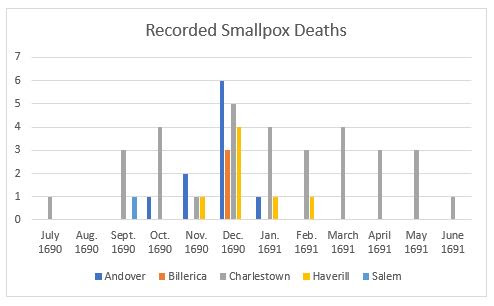
Like my previous smallpox post, the data is limited by who recorded the deaths in each town and whether they included a cause of death. After the 1678–1679 outbreak, the period from 1689 to 1692 had 55 cases. The earliest death was Dr. John Smith in Charlestown on 21 October 1689 and the last was Thomas Rand who died on 17 June 1691, also in Charlestown. Of all the recorded smallpox deaths, Charlestown had the most prolonged time period between the first and last smallpox deaths and the largest recorded deaths (34). The remaining smallpox deaths were in Andover (10), Haverhill (7), Billerica (3), and Salem (1). Clearly, the Charlestown town recorder was more diligent than the Salem one, since we would expect a busy seaport such as Salem to have more cases.

The records did not supply a timeframe for when the virus raged in each community or how many had the disease and survived. However, we do know from the selectmen's records that by mid-October 1690, Martha Carrier and some of her children had smallpox, and all recovered. But, all of the people who died of the disease in Andover were related to Martha, including her father, two brothers, and two nephews.

The Andover selectmen blamed Martha Carrier for bringing the contagion to Andover. The records show that the first smallpox death recorded in Andover was on 24 October 1690, while the first one listed in Billerica occurred two months later, on 24 December 1690. This suggests—but does not prove—that the disease hit Andover first, and Billerica later.


Andover

Andrew Allen jr., small pox. 24 Oct 1690
Andrew Allen Sr., small pox 26 Nov 1690
John Allen, small pox, Nov. 26, 1690.
Francis Ingalls, s. Henry and Mary, small pox, Dec. 9, 1690.
James Holt, "father of James," small pox, Dec. 14, 1690.
James Holt, s. James and Hannah, small pox, Dec. 13, 1690.
Mercy Allen, w. John, small pox, Dec. 25, 1690.
Sarah Marks, w. Roger, small pox, Dec. 22, 1690.
Thomas Allen, s. Andrew and Elisabeth, small pox, Dec. 18, 1690.
Stephen Osgood, smallpox, Jan. 15, 1690-1.

Billerica

Daniel Shed, small pox, Dec. 24, 1690, a. abt. 41. [Dan[ie]ll Jr., M.R.]
Dorothy Shed [dup. Dorithy], d. Daniel Jr. [dup. omits Jr.] and Ruth, small pox, Dec. 23, 1690.
John Dunkin Sr. [h. Johannah], small pox, Dec. 19, [16]90.

Charlestown

Dr. John Smith, smallpox, d. Oct. 21, 1689.
Abigail Kettle, wife of Jonathan Kettle, (smallpox), d. Jan. 25, 1690.
John Damman, about 40, (smallpox), d. Jan. 20, 1690.
John Hett, son of Tho. & Dorothy Hett, (smallpox), d. Jan. 8, 1690.
Susanna Codman, dau. of Stephen & Elizabeth Codman, (smallpox), d. Jan. 8, 1690.
James Miller, son of James Miller, the Scotchman, smallpox, d. July 14, 1690.
John Hale, about 26, (smallpox), d. Sept. [Dec, Co. Rec. 4:182] 30, 1690.
Mary Cutler, dau. of Timothy & Elizabeth Cutler, smallpox, d. Sept. 12, 1690.
Sarah Cutler, dau. of Timothy & Elizabeth Cutler, smallpox, d. Sept. 5, 1690.
Henry Bowers, son of Benanuel Bowers, about 25, (smallpox), d. Oct. 16, 1690.
Mary Hill, dau. of Samuel & Elizabeth Hill, smallpox, d. Oct. 4, 1690.
Sarah Shoorin, wife of Thomas Shoorin, (smallpox), d. Oct. 17, 1690.
William Wilson, son of Paul Wilson, (smallpox) Oct. 4, 1690.
John Hurry, son of Wm. & Hannah Hurry, smallpox, d. Nov. 22, 1690.
Elizabeth Het, dau. of Tho. & Dorothy Het, (smallpox), d. Dec. 14, 1690.
Henry Davis, a sojourner at Jno. Chamberlin's [a stranger, Co. Rec. 4:183], (smallpox), d. Dec. 20, 1690.
John Chamberlain, (smallpox), d. Dec. 22, 1690
John Ryal, son of Joseph & Mary Ryal, 11, (smallpox), d. Dec. 21, 1690.
Joseph Hopkins, about 32, smallpox, d. Dec. 27, 1690.
Alice Dam, servant to Capt. Joseph Lynde, smallpox, d. Feb. 18, 1690/1.
Hephzibah Codman, dau. of Stephen & Elizabeth Codman, (smallpox), d. Feb. 22, 1690 [1690/1, Pro. 1].
Sarah Mirick, wife of Benjamin Mirick, smallpox, d. Feb. 14, 1690/1.
Abigail Orton/Horton, wife of Ebenezer Orton, (smallpox), d. Mar. 27, 1691.
Edward Paine, brickmaker, (smallpox), d. Mar. 13, 1690/1.
John Kettle, about 30, smallpox, d. Mar. 17 [18, Pro. 2], 1690/1.
Thankfull Austin, wife of Ebenezer Austin, (smallpox), d. Mar. 4, 1690 [1690/1, Pro. 1].
[blank] of Jno. Smith, (smallpox), d. Apr. 29, 1691
George Luke, son of George & Hannah Luke [smallpox, Pro. 1], d. Apr. 11, 1691 [altered from 1690].
Samll. Carter, smallpox, d. Apr. 1, 1691.
[blank] of Jno. Smith, (smallpox), d. May 11, 1691.
Anna Ballat, wife of Mr. Samll. Ballat, smallpox, d. May 14, 1691.
Mary Smith, wife of Jno. Smith, (smallpox), d. May 22, 1691,
Thomas Rand, son of Nathaniel & Abigail Rand, (smallpox), d. June 17, 1691.
John Smith, ship carpenter, (smallpox), d. 1691.

Haverhill

Tho[mas] Mash, s. Onisophorus, of Canada, pox, Nov. 21, 1690.
Abraham Hendrick, s. Daniel and Mary (Stockbridge), smallpox, Dec. 1, 1690.
Jonah Sterling, s. William and Mary, small pox, Dec. 21, 1690.
Jonathan Davis, s. Ephraim and Mary (Johnson), small pox, Dec. 7, 1690.
Ruth Hartshorne, w. John, small pox, Dec. 12, 1690
Mary Ford, w. Robert, small pox, Jan. 27, 1690-91.
Mary Ford, d. Robert and Mary (Kent), small pox, Feb. 3, 1690-91.

Salem

Jacob Phillips, small pox, Sept. 19, 1690. C. R. 2.


*Data only included information from Massachusetts Vital Records 1620–1850 database at AmericanAncestors.org, which does not include records for every town. Boston Births, Baptisms, Marriages, and Deaths 1630–1699 were searched separately, though the keywords “smallpox,” “small pox,” and “pox” were not found. 


See also: 


A pox on Martha Carrier (WitchesMassBay)


16 January 2020

Before the court: Massachusetts Bay records

Records of the Court of Assistants of the Colony of the Massachusetts Bay, 1630-1692

1630 to 1641: Records, so far as recovered or reproduced from State Archives
1641 to 1644
1642 to 1673 Restored fragments of records
1673 to 1692 (missing Intercharter period, part 1686-part 1689)

Criminal trials in the Court of Assistants and Superior Court of Judicature, 1630-1700 by John Noble (1897)

Abstract and index of the records of the Inferior court of pleas, Suffolk County Court, Held at Boston, 1680-1698

Records and Files of the Quarterly Courts of Essex County, Massachusetts

Vol. I 1636-1656
Vol. II 1656-1662
Vol. III 1662-1667
Vol. IV 1667-1671
Vol. V 1672-1674
Vol. VI 1675-1678
Vol. VII 1678-1680
Vol. VIII 1680-1683
Vol. IX 1683-1686

Records of the Governor and Company of the Massachusetts Bay in New England

v. 1. 1628-1641
v. 2. 1642-1649
v. 3. 1644-1657
v. 4, pt. 1. 1650-1660
v. 4, pt. 2. 1661-1674
v. 5. 1674-1686

Massachusetts State Archives collection, colonial period, 1622-1788

v. 135 Witchcraft, 1656-1759

FamilySearch record images (click on camera icon on right to view digital records)


27 October 2019

Reconstructing Rev. George Burroughs’ Genealogy

1711 Attainder for George Burroughs & Others
Rev. George Burroughs left his Salem Village post in 1683, preferring life in the Maine wilds with occasional Indian attacks than dealing with the animosity brewing in Salem, Massachusetts. In 1692 he returned to Salem in chains on trumped up charges of being “in confederacy with the Devil.” 

At age 42, Burroughs stood before his former congregation and many other spectators at Proctor’s Ledge with a noose around his neck. He proclaimed his innocence on the charges of witchcraft, then perfectly recited the “Lord’s Prayer.” A sense of unease apparently swept through the crowd afterwards but Rev. Cotton Mather, sitting on horseback, declared it was a “righteous sentence.” Burroughs and four other victims of the Salem witch trials were hanged on 19 August 1692.

Incorporating Corrections to the Burroughs Tree


Over the last 65 years, various researchers have discovered new details about George Burroughs’ family and printed corrections, most notably in articles published in The American Genealogist. Yet we still see the same misinformation being repeated online and in print. I’ve compiled all that data so George can be properly placed with his parents, wives, and children.

Burrough of Wickhambrook


Born about 1650, George was the son of Nathaniel Burrough and his wife Rebecca Stiles. Nathaniel was a merchant/mariner, son of Rev. George Burrough (1579-1653), rector of Pettaugh and Gosbeck in Suffolk, England, and a member of the Burrough family of Wickhambrook. During his son’s childhood, records document Nathaniel’s travels between Maryland and Massachusetts Bay. Records also show in 1657 Rebecca joined the church in Roxbury, Massachusetts, and was dismissed in 1674 to return to England. Rebecca (Stiles) Burrough was buried 26 March 1679 in Stepney, Middlesex, England. Nathaniel was buried there 6 March 1682.

*In England, the surname most often was spelled Burrough without the S, but there were a dozen variations.

Marriage No. 1


The ill-fated minister George Burroughs graduated from Harvard College in 1670. About 1673, he married Hannah Fisher, born 19 January 1652/3 in Dedham, Massachusetts, to Lieut. Joshua Fisher (1621-1672) and his first wife, Mary Aldis (d. 1653). George and Hannah had:

1. Rebecca Burroughs, baptized 12 April 1674 in Roxbury; died 27 January 1741/2, buried at Granary Burying Ground in Boston; married first, 1 December 1698 in Charlestown, Isaac Fowle; married second, 18 October 1716 in Boston, Ebenezer Tolman.
2. George Burroughs, baptized 25 November 1675 in Roxbury; died young.
3. Hannah Burroughs, born 27 April 1680 in Salisbury; died 5 August 1746 in Woburn, buried at First Burial Ground, Woburn; married 8 March 1705 in Boston, Jabez Fox (1684-1736).
4. Elizabeth Burroughs, born in 1681, baptized 4 June 1682 in Salem; died 1719, buried at Granary Burying Ground in Boston; married 2 November 1704 in Boston to Peter Thomas.

Hannah (Fisher) Burroughs died in September 1681, possibly shortly after her fourth child was born. Her ghost appeared in the Salem witch trials records.

Marriage No. 2


About 1683, George married Sarah Ruck, born 12 August 1656 in Salem, died about 1689/90, daughter of John Ruck (1627-1697) and his first wife Hannah Spooner (d. 29 January 1660/1) of Salem. Sarah was the widow of Capt. William Hathorne (1646-1678), son of Major William Hathorne (1606?-1681) and wife Ann of Salem. She had two Hathorne children who died in their minority. The proof of this earlier marriage is in a 1728 deed where her son Charles Burroughs, as his mother's heir, sells Capt. Hathorne's lands in Groton, Mass. Her ghost also appeared in the Salem witch trials records.

On 6 June 1693, John Ruck became guardian of George and Sarah’s four orphans (but not 1st wife Hannah’s children), and in the same month, Ruck had three of them baptized. In his 1697 will, he bequeathed land to his four Burroughs grandchildren:

5. Charles Burroughs, born about 1684, baptized June 1693 in Salem; married first, 3 October 1706 in Salem, Elizabeth Marston (d. 1711); married second, 11 March 1711 in Marlborough, Rebecca Townsend of Charlestown. 
6. George Burroughs, baptized April 1691 in Salem; published marriage intention 27 February 1713/4 in Ipswich to Sarah Scales.
7. Jeremiah Burroughs, baptized June 1693; died unmarried March 1752 in Ipswich. 
8. Josiah Burroughs, baptized June 1693; died after 1701 when he chose Samuel Ruck as guardian and before 1712 restitution.

Marriage No. 3


About 1690, George married his third wife, Mary —, probably in Maine. They had one child:

     9. Mary Burroughs, born about 1690-1692 in Maine, baptized 1 May 1698 in Cambridge, Massachusetts; married Joseph Tiffany probably years before they were warned out of Norton in 1734. She was admitted to the church in Attleborough in 1736.

In her mid-20s when her husband George was hanged, Mary (—) Burroughs married second, 13 July 1693 in Boston, Michael Homer—just months after his first wife Hannah (Dowse) died. In October 1694, Michael was taken to court for spousal abuse before disappearing from the records. In January 1697/8, Mary Homer was admitted a member of the Cambridge church and a few months later had her two daughters, Mary Burroughs and Hannah Homer, baptized. 

On 5 February 1699/1700, Mary (—) (Burroughs) Homer married in Cambridge to Christopher Hall Jr. (d. 1711). They had two children, Caleb (1700-1791) and Joshua Hall (1702-), born in Attleborough.


Sources for Burroughs’ Parents

“Nathaniel Burrough of Maryland, Massachusetts, and England” by George Ely Russell, The American Genealogist, Vol. 60, pp. 140-142, 1972. (TAG back issues are available to members at AmericanAncestors.org)

Genealogical Gleanings in England by Henry F. Waters, Vol.1, Vol. 2. 1:515f, 1:737, 2:1308f


Sources for Burroughs’ Wives & Children

“Homer-Stevens Notes, Boston” by Winifred Lovering Holman in The American Genealogist, Vol. 29, pp. 99-110, 1953.

“Mary (Burroughs) (Homer) (Hall) Tiffany” by Glade Ian Nelson in The American Genealogist, Vol. 48, pp. 140-146, 1972.

“The Third Wife of the Rev. George Burroughs” by David L. Greene in The American Genealogist, Vol. 56, pp. 43-45, 1980.

“Hannah Fisher, First Wife of the Rev. George Burroughs, Executed for Witchcraft in Salem, Massachusetts, 1692” by Neil D. Thompson, The American Genealogist, Vol. 76, pp. 17-19, 2001.

“Sarah (Ruck) (Hathorne) Burroughs of Salem, Massachusetts” by Glade Isaac Nelson in The American Genealogist, Vol. 91, pp. 23-28, 2019.


Originally published 19 Sept. 2017, updated with Capt. Hathorne data.


14 May 2018

The Peabody Essex Museum's Phillips Library collections: a timeline from 1799 to 2018


Inside the Phillips Library in Salem, Massachusetts, 1885
One of the oldest research libraries in the country, Phillips Library contains more than 400,000 rare books and 117,000 square feet of manuscripts, original papers, photographic images, and prints from Salem and Essex county, Massachusetts, to places around the world. It's probably best known as the repository for the 1692 Salem witch trials documents; letters and manuscripts from Nathaniel Hawthorne and his literary circle; plus ships' logs and maritime journals documenting travels to the Far East. 

Of particular interest are local family histories and town records, military records, original genealogical papers, newspapers and city directories, charts and maps, business and social records, papers of notable Americans, works of regional authors, broadsides and ephemera, publications from literary and historical societies, art and architecture books, history books, and materials related to its museum collections.

For more than 200 years, the Phillips Library collection has been an integral part of Salem. The timeline, below, shows how the Phillips Library started and grew—and where it's headed next.

1799 East India Marine Society founded for creating a library on navigation and seafaring topics and collecting curiosities from native cultures of Polynesia, Micronesia, and Melanesia.

1821 Essex Historical Society founded.

1833 Essex County Natural History Society founded.

1848 Essex Institute formed by the union of the Essex Historical Society and Essex County Natural History Society; focus on literary, historical, and scientific pursuits; museum library, historic houses, educational programs, scholarly publications.

1857 Plummer Hall built for Salem Athenaeum with money provided in the 1845 will of Caroline Plummer; Essex Institute rented rooms at Plummer Hall for library and collections.

1867-1868 Peabody Academy of Science formed with the purchase of the East India Marine Hall along with the historic and ethnological collections of East India Marine Society. Essex Institute permanently transferred its natural history collections, originally collected by the Essex County Natural History Society, to the Peabody Academy. The Peabody Academy permanently transferred its historical collections to the Essex Institute, which concentrated its focus on local history, genealogy, and art.

1885 Essex Institute acquired the Daland house for the Phillips Library.

1905 Essex Institute bought Plummer Hall from Salem Athenaeum.

1915 Peabody Academy of Science changed its name to Peabody Museum of Salem, with its focus on maritime history of New England, Pacific and Japanese ethnology, and natural history of Essex county.

1972 National Register of Historic Places approves formation of the Essex Institute Historic District formed within the bounds of the Armory, Essex Street, Washington Square West, and Brown Street.

1992 Peabody Essex Museum (PEM) founded through consolidation of Peabody Museum of Salem and the Essex Institute. Within a few years, PEM changed its focus to become an arts and culture museum.   

1997 PEM’s Phillips Library closed for “massive restoration project, including climate control and modern archival storage” (closed 9 months).

2004 reduced hours and limited access to Phillips Library after laying off all but one librarian. At the same time, PEM said it would put “part of its 400,000 volumes and 2 million manuscript papers on the Internet.” Already 26,000 records had been scanned.

2011 Phillips Library is closed during “preservation and renovation work on Plummer Hall and Daland House (expected completion 2013)” (closed 19 months). During part of the closure, PEM exhibited 35 rare items as part of its Unbound, Highlights from the Phillips Library at PEM exhibit. 

2013 Phillips Library collection moved to temporary collection center in Peabody, with limited access to the library's resources. 

2015 PEM announced “$20 million renovation and improvement of PEM’s Phillips Library....housed in two noted 1850s architectural treasures, the John Tucker Daland House and Plummer Hall, both of which are being renovated by Schwartz/Silver Architects.” Part of the funds were used to digitally catalog the collections in PhilCat.

2017 Peabody Essex Museum purchased building in Rowley for its new Collections Center.

2018 Phillips Library moved to Collections Center in Rowley (closed Sept. 2017 to mid-June 2018). 


28 February 2018

Introducing the Witches of Massachusetts Bay website

As some of you already know, I've been studying, researching, and writing about the Salem witch trials for 20+ years. I love Salem. But when I visit, I expect to see evidence of the 1692 witch trials. But where is the court house? The documents? The tangible objects that remind us of the victims, the accusers, the judges?

Good question.

Instead of blogging these last few months, I've been putting together my new Witches of Massachusetts Bay website. It launched in late January to highlight locations and artifacts as well as provide a calendar of related events, whether you’re headed on a roadtrip, interested in a lunchtime talk on John Proctor, or ready for the Daemonologie experience. I also added information for doing armchair research and, yes, started another blog.

Get Ready for a Roadtrip


Relevant historical and genealogical societies, museums, historic sites, libraries, and cemeteries are listed on the Roadtrips pages by town. In time, I would like to include detailed information about how each one fits into the witch-hunt theme. For example, the Macy-Colby House in Amesbury displays the wooden cradle from executed “witch” Susannah (North) Martin’s family; the Old North Parish Burial Ground in North Andover includes burials of accused witches William Barker Sr. and his son William Barker Jr.; the Danvers Archival Center has books, manuscripts, and pamphlets on witchcraft; and the Beverly Historical Society offers tours of the house where Rev. John Hale wrote his Modest Inquiry book on witchcraft. On the Roadtrips pages, I’ve also included online book and record links.

Witch-Hunt and 17th Century-Focused Events


It seems I always found out about an event after it happened. No more! Now you can find out when a local history society is giving a tour of the Old Burial Grounds, attend a lecture on a family involved in the witch hunts, visit a home connected to the trials, learn about Wampanoag lives, or experience History Camp Boston. The calendar includes ongoing exhibits and special events, like 17th century Saturdays, so you know what's happening before you go.

Help with Research


The Research section includes lists of accused witches and old place names—as well as digital collections, books, records, and multimedia online that encompass more than one location.

Blogging on 'Witches'


The blog is for witch-hunt-related news, the latest research, Q&As with historians, book notices, collections highlights, etc. For example, I did a Q&A with a novelist about her book on accused witch Abigail (Dane) Faulkner; used Google Maps’ fix function to correct which Bishop lived where; and discovered the somewhat unknown witch trial items at the Supreme Court in Salem.

Learning from the Past


By searching for these locations and researching witch-hunt connections, I hope to expand my own understanding, because, ultimately, I think the witch hunts have much to teach us as individuals and as a society. Some of the accused may have dabbled in fortunetelling, folk-healing, and the like, but they were not witches who made pacts with the devil, performed Satanic rites, or shapeshifted to harm their neighbors. They were ordinary people with flaws, just like you and me.

If you're a witch-hunt historian, researcher, descendant, or just curious, check out my Witches of Massachusetts Bay website. I also invite you to sign up for my occasional emails, follow me on Twitter @witchesmassbay and Facebook, and spread the word. Thanks!


16 September 2017

George Burroughs’ genealogy: Burroughs-Thomas-Crocker line

Mather's book, The Wonders of the Invisible World,
shows his passionate dislike for fellow minister
and Salem witch trials victim George Burroughs
Cotton Mather’s profile in Colonial Collegians concludes by claiming a blood connection between the Puritan Boston minister and George Burroughs, the man Mather vilified in his writings on the 1692 Salem witch trials. In my previous post, however, I showed how the Colonial Collegians writer mistook a Joseph for a Josiah Crocker in Mather's line, which removed a marriage between their descendants. 

But what about the line of descent given for George Burroughs, former minister of Salem Village? It turns out the information in Colonial Collegians was almost correct. It skips one generation—the father of Isaiah Thomas, founder of the American Antiquarian Society (AAS)—but the other details check out.

Burroughs line in Colonial Collegians
George Burroughs (H.U. 1670)
[daughter Burroughs]
Isaiah Thomas, LL.D., founder of AAS
[child of Isaiah Thomas]
[granddaughter of Isaiah Thomas] m. Samuel Leonard Crocker (Brown U. 1822)


Isaiah Thomas Sr. (1749-1831),
descendant of George Burroughs,
printer and founder of AAS
Rev. George Burroughs (1650-1692), the 1670 Harvard graduate hanged as a witch in Salem, married as his first wife, Hannah Fisher (1653-1681). Their daughter Elizabeth Burroughs (1681-1719) married Peter Thomas (1683-1744). Elizabeth and Peter’s son Moses Thomas (1715-1752) married Fidelity Grant (d. 1798). Their son, Isaiah Thomas Sr. (1749-1831), married as his first wife Mary Dill (b. 1750). Isaiah was a printer and founder of the American Antiquarian Society in Worcester, Massachusetts. Their son Isaiah Thomas Jr. (1773-1819) married Mary Weld (1768-1825), and they had Hannah Weld Thomas (d. 1827). So, the granddaughter of the founder of the AAS married Samuel Leonard Crocker (1804-1883) who graduated from Brown University in 1822. That makes George Burroughs the third great-grandfather of Hannah (Thomas) Crocker.

For more information on Isaiah Thomas Sr., see the AAS prototype website, Isaiah Thomas: Patriot-Printer. 


23 August 2017

Cotton Mather and the Six Degrees of Separation

Cotton Mather (1663-1728)
“Conspicuous” on horseback, Cotton Mather (1663-1728) attended the hanging of fellow minister and Harvard graduate George Burroughs (1650-1692), found guilty at the Salem witch trials. Called the ringleader of witches, Burroughs’ parting speech followed by a perfect recitation of “The Lord’s Prayer” caused doubt to stir among the onlookers. Yet Mather, who firmly believed in the devil himself, dismissed Burroughs’ words. 

And the executions continued.

Mather held a passionate dislike for Burroughs, despite their similar backgrounds. Perhaps he truly believed the former Salem Village minister conducted devil worship with scores of witches, murdered his two wives (as their ghosts told Ann Putnam Jr.), or turned Baptist. Whatever the cause, a Harvard historian concluded the Boston minister’s biography by claiming Mather was linked to Burroughs through their descendants, no doubt causing Mather to roll over in his grave.

“The name Mather among Cotton Mather’s descendants has long been extinct. His son Samuel Mather, (Harvard University 1723), had a daughter, who married the Reverend Josiah Crocker of Taunton, H.U. 1738, among whose descendants was Samuel Leonard Crocker of Taunton, a graduate of Brown University in 1822, who married a granddaughter of Isaiah Thomas, LL.D., the founder of the American Antiquarian Society at Worcester, whose maternal grandfather was George Burroughs, at whose execution Cotton Mather acted a Conspicuous part on horseback. Thus by the marriage of Crocker to a granddaughter of Thomas, the Cotton Mather family became united with the George Burroughs family.” 
—Colonial Collegians 1642-1774, Harvard, pp. 797-798. (Online database at AmericanAncestors.org.)

So, let’s fill in the missing data to prove six degrees of separation between the two Puritan ministers. 

MATHER
BURROUGHS
Cotton Mather (H.U. 1678, 1681)
George Burroughs (H.U. 1670)
Samuel Mather (H.U. 1723)
[daughter Burroughs]
[dau.] Mather m. Rev. Josiah Crocker (H.U. 1738)
Isaiah Thomas, LL.D., founder of AAS
[among whose descendants was . . .]
[child of Isaiah Thomas]
Samuel Leonard Crocker (Brown U. 1822) m. [granddaughter of Isaiah Thomas]

The first child of Rev. Increase Mather (1639-1723) and Maria Cotton (1642-1714), Cotton Mather was married three times and had 15 children. Unfortunately, childhood diseases and early deaths wiped out most of his children, leaving only three who married. With his second wife Elizabeth Clark (1675-1713), Cotton had a son, Samuel Mather (1706-1785). Rev. Samuel married Hannah Hutchinson (1714-1752) in 1733.


Eligible Harvard Grads


Since we don’t know which Mather daughter married a Crocker, let’s return to the Colonial Collegians biographies.

Josiah Crocker (H.U. 1738) was a minister at Taunton but he married Rebecca Allen (p. 4451). The Taunton vital records show Josiah died in 1774, age 55, and he’s buried next to his wife Rebecca Allyn Crocker (1721-1759). He married his second wife, Hannah Cobb, in 1761 (Taunton VR). Born in Yarmouth in 1719, he was the only son of Capt. Josiah (d. 1721) and Desire (Thacher) Crocker (Yarmouth VR).

Josiah Crocker (H.U. 1760) was born 1740/1741 in Eastham, son of Rev. Joseph Crocker (H.U. 1734) and Reliance Allen. He died in 1764, unmarried (p. 6681).

Josiah Crocker (H.U. 1765) was born 1744 in Barnstable to Cornelius Crocker, tavernkeeper, and Lydia Jenkins. He married Deborah, daughter of Daniel Davis, and died in 1780. He lived in Barnstable and was a schoolmaster and clerk (p. 7319).

We’ve run through all the possible Josiah Crockers in Colonial Collegians, and even though Josiah and Joseph are not interchangeable names, there could be some confusion between generations. So, let’s continue.

Joseph Crocker (H.U. 1734) was a minister in Orleans. Born in 1715, he was the son of Thomas (d. 1728) and Hannah (Green) Crocker of Barnstable. He and his wife Reliance (Allen) Crocker were the parents of Josiah (H.U. 1760), above. He married, second, Mary (Pemberton) Hatch, widow of James Hatch, in 1766. He died in 1772 (p. 4053).

Joseph Crocker (H.U. 1774) was the son of Rev. Josiah Crocker (H.U. 1738) and Rebecca Allen mentioned above. He was born in Taunton in 1749 and died in Boston in 1797. He was a military man, not a minister like his father. And he was the husband of Hannah Mather (1752-1829), daughter of Rev. Samuel (p. 8627).


Finding Parents for a Match


Now that we’ve solved the Mather-Crocker marriage, we have to skip a generation or two to find out who were the parents of Samuel Leonard Crocker, Brown University 1822. For that, we go to the Massachusetts vital records.

In Worcester in 1825, Samuel L. Crocker married Hannah W. Thomas, the granddaughter of Isaiah Thomas. Born in Taunton in 1804, Samuel was the son of William Augustus Crocker and Sally Ingell. William was the son of Capt. Josiah Crocker and Abigail Leonard. Capt. Josiah was the son of Rev. Josiah Crocker and Rebecca Allen of Taunton, above. The family tree looks like this:

1. Capt. Josiah Crocker (d. 1721) m. Desire Thacher
2. Rev. Josiah Crocker (1719-1774) (H.U. 1738) m. Rebecca Allen
3. Capt. Josiah Crocker (1743-1808) m. Abigail Leonard
4. William Augustus Crocker (1774-1805) m. Sally Ingell
5. Samuel Leonard Crocker (1804-1883) m. Hannah Weld Thomas
                    3. Capt. Joseph Crocker (1749-1797) m. Hannah Mather

The Colonial Collegians biography had Cotton Mather’s granddaughter marrying Rev. Josiah Crocker (H.U. 1738), who was a generation older than her, instead of his son. Then it was the wrong son (Joseph, not Josiah). To clarify, Hannah (Mather) Crocker was the grand-aunt of Samuel Leonard Crocker who married Hannah Weld Thomas. That means Cotton Mather and George Burroughs were not related by blood through this line.

Fortunately, the Harvard Crocker biographies do not mention the false Mather/Burroughs connection. Nor does the Horace E. Mather’s Lineage of Rev. Richard Mather (1890). But you will see mention of it in other sources.

Postscript: Hannah (Mather) Crocker


Hannah became well-known for her writing and good works. She believed in the equality of women, as shown in Observations on the Real Rights of Women (1818), and supported a women’s educational “lodge” based on Masonic principles. You can learn more about her by visiting the Hannah Mather Crocker Society online, which promotes “scholarship and public understanding concerning the life, writing, and legacies of Hannah Mather Crocker (1752-1829).” 

In 1814—more than a decade before the Crocker-Thomas marriage—Hannah (Mather) Crocker donated 1,500 books from the Mather family to the American Antiquarian Society in Worcester, founded in 1812 by Isaiah Thomas LL.D. (1749-1831). Her descendants also donated manuscripts, portraits, and other ephemera to the society. 


To find out if the Burroughs line in Cotton Mather's Colonial Collegians profile is correct, read George Burroughs Genealogy: Burroughs-Thomas-Crocker Line.


16 August 2017

Remembering Salem: Symposium on the Lessons and Legacy of 1692

Salem's Trials symposium
One of the reasons why the Salem witch trials of 1692 still resonate today is the quest to understand why it happened. Plenty of theories abound to answer that question. Yet we’re still trying to learn the lessons today.

On June 10, 2017, the 325th anniversary of the first witch trials hanging, people gathered for a special symposium, Salem’s Trials: Lessons and Legacies of 1692, sponsored by Salem State University’s history department, the Salem Award Foundation, and the Essex National Heritage Area. Fortunately, C-SPAN recorded four sessions. If you didn't attend this great symposium, here's your chance to learn from a stellar group of speakers.

⏯ Emerson Baker, Salem Witch Trials 101 (includes symposium opening remarks)

A professor of history at SSU, Tad Baker is the author of A Storm of Witchcraft: The Salem Trials and the American Experience.


Project manager for the Records of the Salem Witch-Hunt, Margo is a popular speaker, particularly in October.

⏯ Panel Discussion, The Making of Witch City

Emerson Baker; Donna Seger, professor of history, SSU; Bethany Jay, associate professor of history, SSU; Steve Matchak, professor of geography, SSU; and Marilynne K. Roach, author of The Salem Witch Trials: A Day-by-Day Chronicle of a Community Under Siege.


A professor of geography at the University of Connecticut, Ken Foote is author of Shadowed Ground: America’s Landscapes of Violence and Tragedy.

Two other breakout sessions were not recorded: Teaching the Trials with Brad Austin, Amanda Prouty, and Jacqueline Robichaud; and The European Context for Salem 1692 by Donna Seger. (Amazingly enough, Donna packed a lot of information into one hour. I've got several pages of notes.)

19 April 2016

Using restitution lists from the 1692 Salem witch trials to rebuild Dorcas Hoar’s family


After the Salem witch trials were over and the victims were released from prison, some families petitioned the government for restitution and reversal of attainder. These records are useful for rebuilding families.


A Bittersweet Homecoming


When Dorcas Hoar was accused of witchcraft in April 1692, she was a recent widow in her late 50s, no doubt struggling financially to survive in her humble abode in Beverly. After many months of imprisonment, she came home to find what little she had was confiscated, even her bed. In 1696, her husband’s estate was probated, showing William’s assets, including five acres and the remainder of an old house, were worth less than his debts, so everything went to his creditors. Without a reversal of attainder, Dorcas probably was not entitled to her widow’s third since legally she was still guilty of witchcraft, a capital crime.

Settling Debts


On 13 September 1710, John and Annis King petitioned for restitution on behalf of Dorcas Hoar. Besides providing acknowledgment of a wrongful imprisonment (and, in some cases, death), this act allowed some victims and their families to receive money for associated costs. In the case of Dorcas Hoar, her family was paid for jail costs, travel expenses, and items taken from her home, including two cows, an ox, a mare, bedding, curtains, and household stuff. We know Dorcas was dead by this date because the full amount of £21 17s was split between her heirs.

By the time the heirs received the money, there were some changes in the family, as shown in the following chart.

13 Sept. 1710 list
19 Feb. 1711/2 receipts
Wm. Hoar 3 children
William Hoar Dec’d left 3 daughters
Mary Birtt
Mary Burt widow
Eliz Reed
Elizabeth Read wife of Christopher Read
Annis Kinge
Annis King wife of John King
Joanna Green
Johanna Green wife of widow
Tabath Slue 3 children
Tabitha Slue dec’d left two children her Leonard & R[a]chel

Using the two lists gives us extra details, providing more information to create a basic genealogy.

The Family of Dorcas (Galley) Hoar


Dorcas Galley, daughter of John Galley (b. abt. 1605, d. 1683) and Florence (d. 1686), was born about 1635 in what is now Beverly, Massachusetts. She married, about 1655, fisherman William Hoar (b. abt. 1628, d. winter 1691/2). They had at least eight children, though no birth dates are recorded in the Beverly vital records:

1. Mary Hoar married in Beverly (1) on June 30 1671 Samuel Harris (probate 1682). In 1710, she was called “Birtt” and in 1712 “Mary Burt widow,” suggesting her husband may have died within those 17 months, however no death or probate records were found. It's possible she married in Marblehead (2) 4 Sept. 1684 as Mary Harris and John Bush, “both inhabitants at Basriner” [Bass River, a.k.a. Beverly]. A “___ Burt, widow,” died before May 1732 in Beverly. She had at least one child, Daniel Harris, born 31 March 1672 in Beverly.

2. Elizabeth Hoar married in Beverly (1) on 13 Nov. 1676 Jonas Johnson and (2) Christopher Read in 1682. Six Read children were recorded in Beverly. Christopher Read was the sexton in Beverly from 1715 to 1727. He may have died in 1727, since Elizabeth was his widow when she died between September 1736 and June 1737.

3. Tabitha (“Tabbie”) Hoar married Leonard Slue/Slew about 1677 as her wedding is mentioned in the 1678 court case. She was baptized as an adult a week after her sister-in-law Sarah (Ross) Hoar, on 22 Dec. 1695, in Beverly. In 1700, Leonard Slue had land in Purpooduck (Cape Elizabeth), Maine. On August 10, 1703, 26 people in Purpooduck were killed by Indians, including Leonard Slue, his wife, and three children. (However, “__ Slue” appears on a 1710/1711 list of persons still being held captive.) Three children were living in 1710, but only two in 1712. (1) Mary Slue married Joshua Beans in Salem on 23 June 1701 and died before he married, second, Mary Fuller on 7 June 1704. (2) Leonard Slue married Abigail Johnson in Beverly on 23 Nov. 1703. He was the sexton in Beverly from 1727 to 1737 and died in 1744. (3) Rachel Slue died unmarried in Beverly in 1734.

4. William Hoar Jr. was born about 1661. He married 3 June 1685 in Beverly Sarah Ross. His wife was baptized and admitted into full communion with the Beverly Church on 15 Dec. 1695 and their four daughters were baptized 2 Feb. 1695/6. William and one of his daughters died before the September 1710 list. Children: (1) Mary married in Marblehead on 18 Nov. 1708 Moses Pitman Jr. (children born 1711-1723); (2) Rebecca Hoar married in Marblehead 22 Dec. 1712 Benjamin Carder; (3) Abigail Hoar married John Grover on 8 Dec. 1715 in Beverly; leaving (4) daughter Sarah Hoar the one who died by September 1710. William's widow, Sarah (Ross) Hoar married James Taylor Sr. in Beverly on 21 June 1720.

5. Annis (“Nancy”) Hoar married in Salem on 10 Sept. 1688 John King (1661-1718) and had at least six children. She was still living in 1731.

6. Samuel Hoar was in court in July 1678 with his father for “neglecting the public ordinances.” No further record; he died before September 1710 list.

7. Simon Hoar was in court February 1678/9 with sisters Elizabeth Johnson and Annis Hoar, for “abusing Mr. Hale’s cattle,” probably in retribution for the burglary ring charges of 1678. No further record; he died before September 1710 list.

8. Joanna Hoar married in Salem (1) on 25 April 1694 Moses Parnell (b. 1670) and (2) on 27 Oct. 1699 to Benjamin Green (b. 1678). Joanna was widowed by 12 Feb. 1712. No children recorded.


Sources:

Bernard Rosenthal et al, Records of the Salem Witch-Hunt

Robert Charles Anderson, Great Migration: Immigrants to New England 1634-1635 (AmericanAncestors.org)

Massachusetts Vital Records to 1850 (AmericanAncestors.org)

Torrey's New England Marriages to 1700 (AmericanAncestors.org)

Essex County MA: Probate File Papers, 1638-1881 (AmericanAncestors.org)

“'Where Thieves Break Through and Steal': John Hale versus Dorcas Hoar 1672-1692” by Barbara Ritter Dailey in Essex Institute Historical Collections, Vol. 128, (1992). 

Records and Files of the Quarterly Courts of Essex County, Massachusetts

Sidney Perley, History of Salem, Massachusetts

George Walter Chamberlain, Descendants of Michael Webber of Falmouth, Maine and of Gloucester, Massachusetts